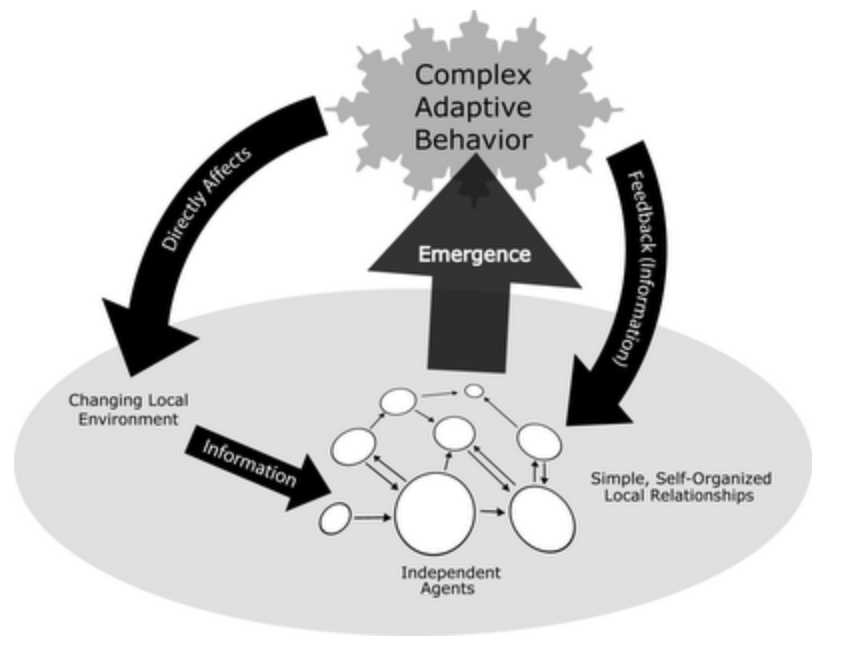
To evaluate the necessity of the U.S. Department of Education (ED) solely through the lens of stagnant National Assessment of Educational Progress (NAEP) scores is to mistake a single downstream metric for the health of an entire ecosystem. Critics frequently cite flat 30-year trends in reading and math in the United States as evidence of ED’s failure. Yet, this critique rests on a fundamental misunderstanding of how educational outcomes are produced. Student achievement in public K-12 education is not a linear function of federal policy; it is the product of a complex adaptive system driven by a minimum of ten closely interconnected variables, the majority of which operate entirely outside the classroom wall and well beyond the functional and legal scope of the Department of Education.
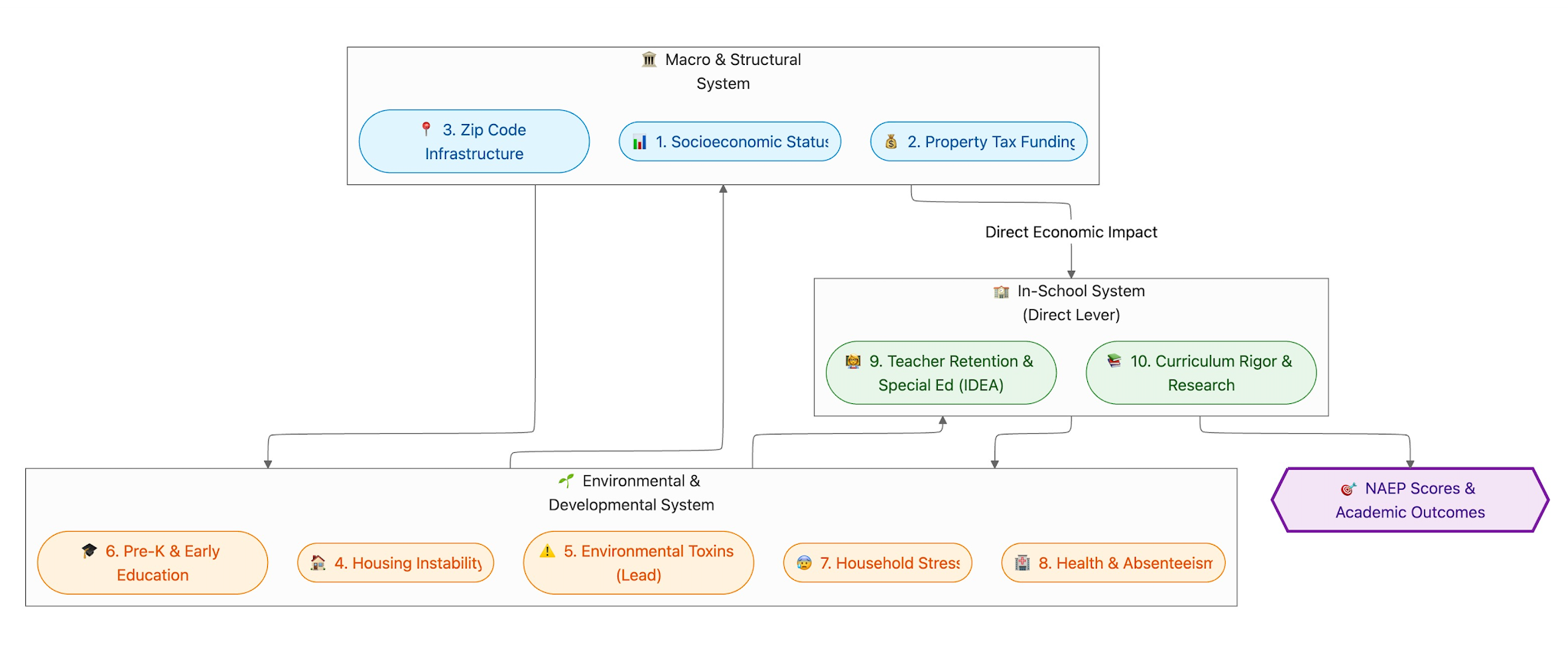
At the macro level, educational outcomes are heavily conditioned by (1) family socioeconomic status and (2) hyper-local property tax funding models, which inherently concentrate resources in affluent zip codes while leaving low-income districts structurally underfunded. These macro drivers leave a vast portion of the nation’s 50 million public K–12 students in districts stripped of the basic funding needed to support cognitive growth. In addition, almost 60% of the 50 million are eligible for Title 1 programs, which means their families are “struggling economically.”1
These macro drivers bleed directly into community conditions: (3) neighborhood resource equity and (4) housing instability. When families face skyrocketing rents or residential displacement, children experience frequent school transfers and high rates of chronic absenteeism—factors that degrade academic performance long before a student sits down for a standardized test. Officially, the federal government counts roughly 3% of K-12 public school students as lacking a fixed, regular, and adequate nighttime residence.2 However, when you account for families who are severely rent-burdened (paying more than 50% of their income on rent) or living in severely inadequate conditions, the Urban Institute estimates that over 5 million children under 18 fall into this category.3 That translates into nearly 10% of all K-12 students who are dealing with systemic housing instability.
Compounding these economic realities are critical early childhood and environmental determinants that impact development. Early childhood exposure to (5) environmental neurotoxins, such as lead paint in older housing stock, inflicts irreversible cognitive and impulse-control deficits that no instructional method can fully undo. Similarly, lack of access to (6) high-quality preschool, exposure to (7) toxic household stress, and baseline (8) physical health and nutrition deficits dictate a child’s neurological school readiness. When a student enters kindergarten behind in language development due to unrelieved early-life stressors, the school system is forced to spend years playing catch-up against compounding non-school disadvantages. These factors fall squarely under the jurisdiction of housing, health, and environmental agencies, completely outside the governance of the Department of Education.
It is only at the very end of this causal chain of non-school factors that in-school variables—such as (9) teacher recruitment and retention, and (10) efficacy of curricula—become highly influential. Of these te holistic drivers, federal educational policy has direct leverage over only the final three, alongside targeted financial interventions designed to cushion the shocks of the first eight. Expecting the Department of Education to single-handedly drive up national NAEP scores while holding zero authority over local housing policy, environmental health standards, or municipal tax structures is a fundamental policy misdiagnosis. Evaluating federal policy solely on raw test scores ignores how programs like Title I and the Individuals with Disability Act (IDEA) actively prevent broader socio-environmental pressures from widening the achievement gap even further. The Department of Education cannot stop the ravages of systemic poverty, but it remains the primary mechanism keeping the boat afloat.
Our goal should be to fix what’s not working, thereby supporting the 50 million K-12 public students. Dismantling the Department of Education signals we are willfully blind to the complex adaptive system that educates future generations to be informed, productive citizens. President John F. Kennedy brought our attention to the phrase “a rising tide lifts all boats,”4 using it to mean that a growing economy helps everyone. In the same vein, a healthy, functioning Department of Education will lift all students so long as our society accepts responsibility for the complexity of the system we have built.
References:
Footnotes
- https://nces.ed.gov/fastfacts/display.asp?id=158 ↩︎
- https://nche.ed.gov/mckinney-vento-definition/
↩︎ - https://housingmatters.urban.org/articles-features/how-housing-instability-affects-educational-outcomes
↩︎ - https://www.jfklibrary.org/learn/about-jfk/life-of-john-f-kennedy/john-f-kennedy-quotations ↩︎
Featured Image: By Joe Graham – Own work, CC BY-SA 3.0, https://commons.wikimedia.org/w/index.php?curid=29128674


Leave a Reply