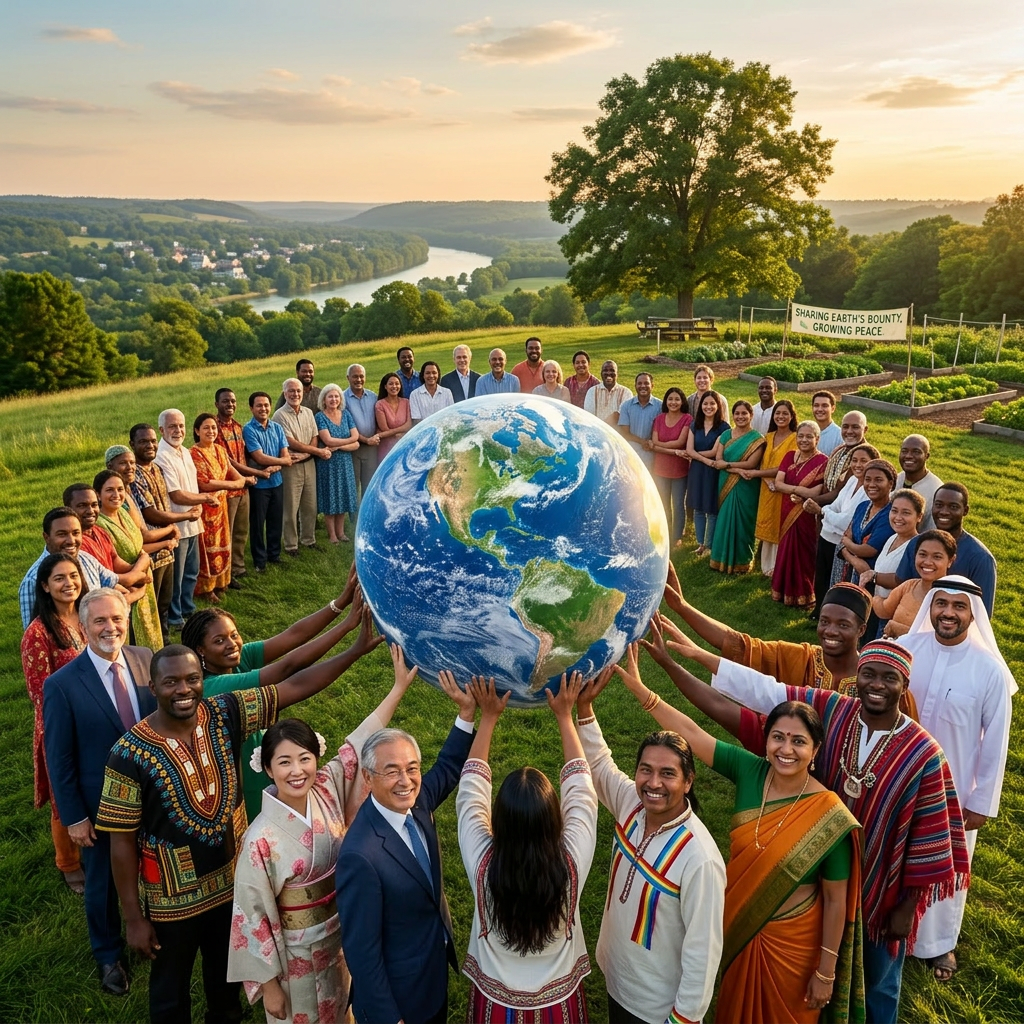
Conversations aimed at achieving peace have been in the news over the past few years. We hear it from different angles.
- Will Israel and Middle East countries achieve lasting peace?
- President Trump claims to have achieved peaceful settlements in six to ten foreign conflicts.
- Ukraine and Russia have not formally entered into a peace or ceasefire agreement to end their war.
- The Sudan Civil War rages on with peace negotiations stalled.
- The Mediation Support Unit of the United Nations catalogs 1,300 documents that can be understood broadly as peace agreements going back to 1934.1
Yet, countries to this day are unable to live “peacefully” with one another. When differences arise or a desire to exercise control emerges, war seems to be the default. Why don’t we peacefully dialogue about the differences and negotiate before bombing and killing soldiers and innocent people? Why is it nearly impossible to share, listen, understand, and modify our expectations so that we can live in peace, so that every human being has the resources to thrive?
What does peace mean, and how would we know we were living in a peaceful time? Living in peace means resolving conflicts without violence and respecting diverse beliefs, cultures, and ways of life. It is not the absence of all disagreements, but rather a collective decision to prioritize mutual understanding, human rights, and cooperation. A world with truly peaceful coexistence would fundamentally transform societies, economies, and the environment because the accumulated wealth of countries could be allocated to enable people to thrive to their full potential.
To me, peace is an active, ongoing practice rooted in how we relate to one another. It begins with a profound willingness to listen and embrace dialogue, driven by a genuine desire to learn and understand. By maintaining mutual respect regardless of our differences, we create a foundation where disputes can be reconciled long before antagonism and hostilities arise. This proactive approach to harmony places immense value on community, actively working to lessen the pain of human isolation by sharing our resources and utilizing our power for the common good.
Furthermore, living peacefully requires courageous accountability—a constant willingness to face the consequences of our actions and a steadfast desire to build rather than destroy. It necessitates opening our eyes to the inherent evil of weapons of mass destruction and unmanned combat aerial vehicles, choosing to reject the tools of devastation. Ultimately, true peace is found in embracing harmony and equilibrium as an active antidote to chaos and uncertainty, allowing us to cultivate a world defined by mutual thriving rather than conflict.
It would be unlikely, in a world where these ideas are actively employed, for disagreements to explode into acts of violence leading to war, especially if vast stockpiles of weapons were not in play.
Here are some other questions that arise for me as I wonder about the challenges of “living in peace.”
- If there were fewer weapons in the world, would this create the conditions for a peaceful world with less violence? Ten countries account for $2.1 trillion in military spending, and the United States’ share is 46%, by far the largest.2
- Does the current technology of drone warfare and sophisticated short and long-range missiles make it more likely that humans distance themselves from the consequences of violence and war, making peaceful reconciliation more difficult?
- Since the wall of nuclear deterrence has fallen away, does the fear of a nuclear device being used create deeper layers of fear? Also, does the lack of mutual deterrence create the desire for other countries to secure a nuclear weapon?
- Do countries and their leaders sincerely value basic human rights?
With respect to the last question, if we answer it in the affirmative, then it means we would be willing to invest in behaviors centered on sharing, stewarding, and closing the gap between those who have and those who don’t. The vast inequities that exist between developed and developing countries only exacerbate the problems of failing to listen, learn, and understand.
Human history can be defined by entrenched, anthropocentric hierarchies that have prioritized resource hoarding over shared prosperity. When governments fail to uphold basic human rights, it’s rarely an isolated political misstep; rather, it is a sign of a broader system built on concepts of dominance and extraction. To achieve lasting global peace, we must transition away from these out-of-date models and embrace the interdependent networks that actually sustain life. Recognizing our deep ecological and social interconnectedness shifts the entire paradigm. It demands that we view peace not merely as a temporary ceasefire between nations, but as a holistic equilibrium where human thriving perfectly aligns with the health of our shared planet.
As an example, comparing the average wealth in the United States, one of the wealthiest countries, to that of the Democratic Republic of the Congo (DRC), one of the poorest countries, the difference couldn’t be more stark.
- The average net worth per adult in the U.S. is roughly $600,000. In contrast, the DRC’s GDP per capita (a measure of economic output per person) sits around $700.3
- Average monthly wages in the U.S. are about $6,000, whereas average incomes in the DRC are less than $100 per month.
It is hard to imagine how we can live in a peaceful world when people in the ten wealthiest countries on average earn 50-100 times more per month than people in the ten poorest countries. 4 Basic needs of clean water, adequate and nutritious food, medical care, and shelter cannot be guaranteed.
When unmet basic needs (like housing, healthcare, or food security) collide with ideological struggles over power and community cohesion, the result is deep societal discord, which can lead to violence. When religious ideologies collide, and people fail to understand and accept the other, deep discord emerges, which can lead to violence.
We have to demand that leaders and governments understand and live by the basic principles that serve as the foundation for a peaceful world. After visiting the Nobel Peace Center in Oslo, Norway, I left with a deeper understanding of what peace means and how the 114 individuals and 28 organizations have contributed to building a better world. We still have work to do.
- United Nations, Mediation Support Unit (MSU), Peace Agreements ↩︎
- Military spending by country in 2026, World Population Review ↩︎
- World Bank Group ↩︎
- Our World in Data ↩︎


Leave a Reply