Introduction: Network vs. Hierarchy
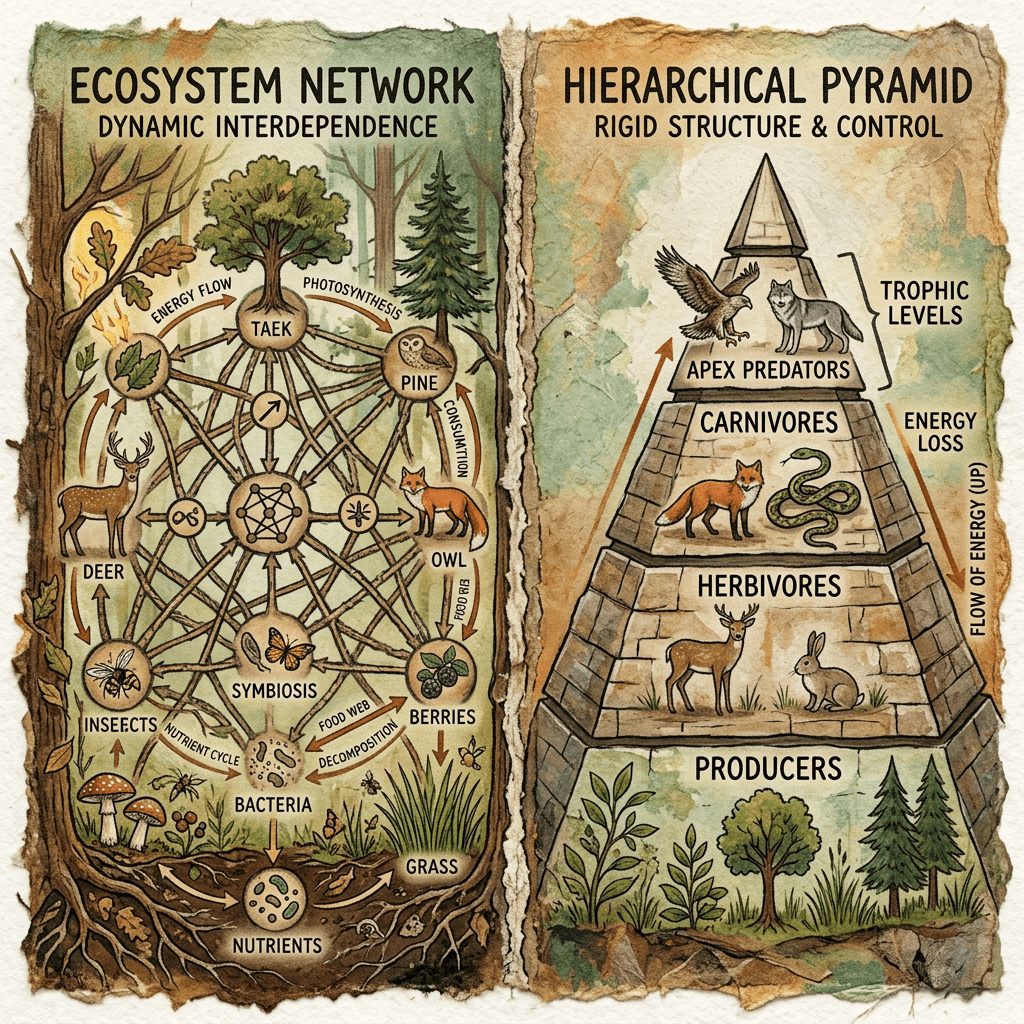
Humans have put on the mask that places us at the apex of all things on Earth, living and nonliving. We have skewed theology and science into a hierarchical story where we hold authority over the great chain of life on Earth. In contrast, indigenous wisdom, theology, science, and other disciplines create stories with humans as one part of the complex web of life. In the words of Thomas Berry, all these traditions agree “in the intimacy of humans with the natural world in a single community of existence.”1 Humans in community imply an interconnected web of relationships, whereas humans at the apex conjure up the idea of a pyramid with us in the dominant position.
In anthropology, geology, and evolution, we speak of modern times as part of the Anthropocene, a sub-epoch when human activities represent the dominant force of change on our climate and ecosystems.2 While the Earth has been in existence for 4.6 billion years, the Holocene epoch began about 12,000 years ago after the last Ice Age. 3 Anthropocene, a part of the Holocene, has been in existence since the early 1900s and has yet to be considered an epoch on its own. The Age of Humans represents the time of significant population growth, industrial activity, fossil fuel consumption, and environmental and species degradation.
While the hierarchical model has driven industrial and technological progress, it has led to ecological instability at all levels of our planet. Transitioning to a network-based understanding of living systems, the web-of-life model, is essential for long-term planetary survival of all living and nonliving things.
The Hierarchical Model: The Apex Predator Myth
Why have we promoted a hierarchical model for managing our local and global systems? Could it be that anthropocentrism is a coping mechanism to advance our evolutionary foothold on the future. Placing ourselves at top gives us permission to ignore the burden of addressing complex environmental challenges and justifies us taking more than we give for our own survival?
Humans, at the Apex of the pyramid, have created significant and complex challenges for our species in the 21st Century. Since the start of the Industrial Revolution in the late 19th Century, our view of self within the hierarchical model has led to the design of an extraction economy that drives how we use living and nonliving resources. We see the Earth as a resource bank that holds all things humans need to expand their footprints, often at the expense of other living things.
The Bible presents humans as the ultimate of earthly creation, created in God’s image.4 We interpret this to mean we rule over the earth, as decision-makers, not as stewards. Positioned at the apex of the creation narrative, humans assume dominion over all living and nonliving things. But of course, the Bible also expects us to manage the earth responsibly on God’s behalf. We often lose sight of that subtle point.
An example of the perils that emanate from a hierarchical model of management is overfishing.5 The oceans are significantly overfished. Marine biologists evaluate fish populations (stocks) using catch data, tagging programs, and research vessel surveys. Comparing the population size and reproductive rate to the number of fish caught, they can establish biologically sustainable limits. According to the Food and Agriculture Organization of the United Nations (FAO), approximately 35.5% of global fish stocks are considered overfished, meaning they are being caught faster than they can naturally reproduce. 6
The hierarchical model is linear, top-down, and relies on an extraction mindset. Humanity is the manager of the Earth’s resource bank and the ‘owner’ of our biosphere. It’s OK to take more than you give back when you see yourself as the owner rather than the steward. However, there is another way to manage our responsibilities to our home.
The Network Model: Earth as a Living System
In the 1970s, James Lovelock and Lynn Margulis created the GAIA Hypothesis, which proposes that the Earth is a single ‘organism’ that maintains its equilibrium as a result of the interdependence of all living and non-living things. 7 GAIA fits well with a systems thinking approach to complexity because it views Earth not just as a rock with life on it, but as a holistic system where living organisms and inorganic surroundings (air, oceans, rocks) are tightly coupled or interdependent.
Their hypothesis shifts our thinking from domination to interdependence. Ecologists write about mutualistic relationships between organisms in which they rely on one another for their existence.8 For example, the mycorrhizal networks in a forest function as an interconnected web linking the root systems of all the trees so that they can communicate and exchange nutrients. 9 The fungi comprising the network benefit from the nutrients that the trees produce through photosynthesis, while the trees benefit from the communication highway set up by the mycorrhizal network. Domination is not the goal; collaboration is.
In this network model (GAIA) with Earth as a living system, humans are simply one part of the system, not acting as ‘kings’ in control, but functioning as collaborative partners. For continued survival, humans must transition from acting as kings to acting as self-aware, intelligent members of the planet, working to maintain the Earth’s equilibrium.
Let’s contrast the two models further.
The Polarity
A polarity is at work when we think of humans: do we view them at the top of the food chain, or just as members of the complex web of life on Earth? When we envision ourselves ruling over all things on Earth, we need to satisfy our insatiable need for resources by taking more than we give. Endless growth is the endgame. Whereas, if we are simply members of the complex network, then stability of the web of life becomes our goal. We support homeostasis and give back more than we take to maintain equilibrium.
In the hierarchical model, top-down control is the way we manage challenges and opportunities. Whereas, in a complex network model, we manage using a distributive process that relies on collaboration. We are aware of feedback loops that dictate a dynamic way of being that requires us to be resilient.
There is an illusion of independence in the hierarchical model with humans at the apex of the pyramid. The very geometry of a pyramid requires a foundation, the base upon which the apex rests. Therefore, the idea of a hierarchy seems foolish because humans cannot function without the base, bacteria, fungi, plants, other living organisms, and the non-living structures that support the system. The network model, the GAIA Hypothesis, is the more beneficial model.
In nature, networks manage growth through collaboration, feedback loops, and optimizing resource allocation. Instead of command from the top, networks like root systems, blood vessels, and food webs grow by taking signals from their local environment. They branch out when resources are abundant, merge to build redundancy, and prune the system to conserve energy. Networks are not stagnant. They are dynamics systems.
Synthesis: Reimagining the Human Role
What should be our species role in the network model on which we rely? First, we should consider moving from dominating the system to participating in it. How would our behaviors and structures, like our economies, change? We would shift from an extraction economy to one that is centered on stewardship and replacement, keeping our sights tuned to maintaining equilibrium. We would share and distribute resources more equitably, lifting all boats. Disparity in wealth and access to resources creates tension in the whole system.
A ‘whole-system’ approach would shift our understanding of how disruptors to the network dictate a response. Understanding the feedback loops demands a more nuanced response to a disruption. For example, when wolves were selectively removed from Yellowstone Park to protect the livestock and game animals, to address a human need, the elk population exploded. Wolves, a natural predator for elk, kept the system in equilibrium. This caused widespread overgrazing by the elk that degraded aspen and willow habitats. With these habitats degraded, populations of animals that relied on them began to decrease. Yellowstone’s riparian ecosystem along rivers and streams was undermined. A perturbation to one part of the network eventually affects the supposed apex.10
I think it is reasonable to view the hierarchical model as a fabrication of our misrepresentation of theological literature. We assume, or it’s our interpretation, that we have a God-given right to dominate. But we must remember that the Bible refers to our responsibility to stewardship. A direct reference in Genesis states that God placed humanity in the Garden of Eden “to work it and take care of it.” 11 It is possible to interpret the Bible’s reference to mankind being in “dominion” over the Earth as a responsibility to steward Earth’s resources in God’s image, in a good and loving rule. In that way, we can’t escape the responsibility of modulating our extraction economy.
The network model is a scientifically accurate representation of reality. Our Biosphere is a complex structure of interwoven ecosystems comprising diverse living and nonliving things. We are simply one of the organisms in the Biosphere. No more or less important than any other functioning part of the system. All parts of the system must be healthy for the system to thrive.
Our call to action is to shift our mindset from an industrial and technological growth-oriented society to a life-sustaining society. The former extracts and takes more than it gives back, while the latter understands that giving back is our responsibility if we want future generations to benefit from the beauty of what Earth has to offer us. This call to action would necessitate seeing ourselves as not above Earth but of Earth. If this call to action is accurate, what is our individual responsibility to change for the good of all?
- The Great Work: Our Way Into the Future, by Thomas Berry, 1999 ↩︎
- Anthropocene, overview in Wikipedia ↩︎
- Holocene, National Geographic, Education, Anthropocene and Holocene ↩︎
- Bible, Genesis 1:26-28. While it doesn’t state this exactly, it has been used to justify the hierarchical model that governs human activity on Earth.
↩︎ - Overfishing, the World Wildlife Fund summarizes the causes and impact. ↩︎
- Food and Agriculture Organization of the United Nations, FAO releases the most detailed global assessment of marine fish stocks to date, November 6, 2025
↩︎ - Institute for Contemplative Psychology, The Gaia hypothesis: James Lovelock & Lynn Margulis, by Christopher Peet, PhD, Professor of Psychology at The King’s University, Edmonton, Alberta. ↩︎
- Mutualism, overview in Wikipedia ↩︎
- National Forest Foundation, Underground Networking: The Amazing Connections Beneath Your Feet. ↩︎
- The strength of the Yellowstone trophic cascade after wolf reintroduction, William J. Ripple et.al., Science Digest, January 12, 2025. ↩︎
- Genesis 2, verse 15 states, God placed humanity in the Garden of Eden “to work it and take care of it.”
↩︎


Leave a comment