
Most recently, I have become interested in the relationship between political stability and prosperity in governing. This interest comes on the heels of tumultuous years of leadership under Donald Trump’s presidency in the United States. Research into a connection between political stability and prosperity in governing frequently cites the following pivotal paper and project. How might this research offer insights into the challenges we face in the U.S. today?
Before we look at the research, let’s set the context with two data sets from 2016 to the present.
- The January 6 Capitol Riot (2021) is widely cited as the most significant challenge to U.S. political stability since the Civil War.
- Election Subversion Narratives following the 2020 election. The proliferation of “The Big Lie, “1 false claim that the election was stolen, led to a decline in public trust in election integrity.
- Assassination Attempts (2024): Donald Trump survived multiple assassination attempts during the 2024 campaign, including a shooting at a rally in Butler, Pennsylvania.
- Threats Against Officials: Documented spike in threats against election workers, judges, and members of Congress, forcing many experienced civil servants to leave their positions. Some officials, like Melissa Hortman in Minnesota, were killed.2
- Civil Unrest: A convergence of protests, such as those following the death of George Floyd in 2020, and mobilization by far-right extremist groups has created a more volatile and unpredictable domestic security situation. We have seen further unrest with the two recent ICE killings in Minnesota of Renee Good and Alex Pretti.3
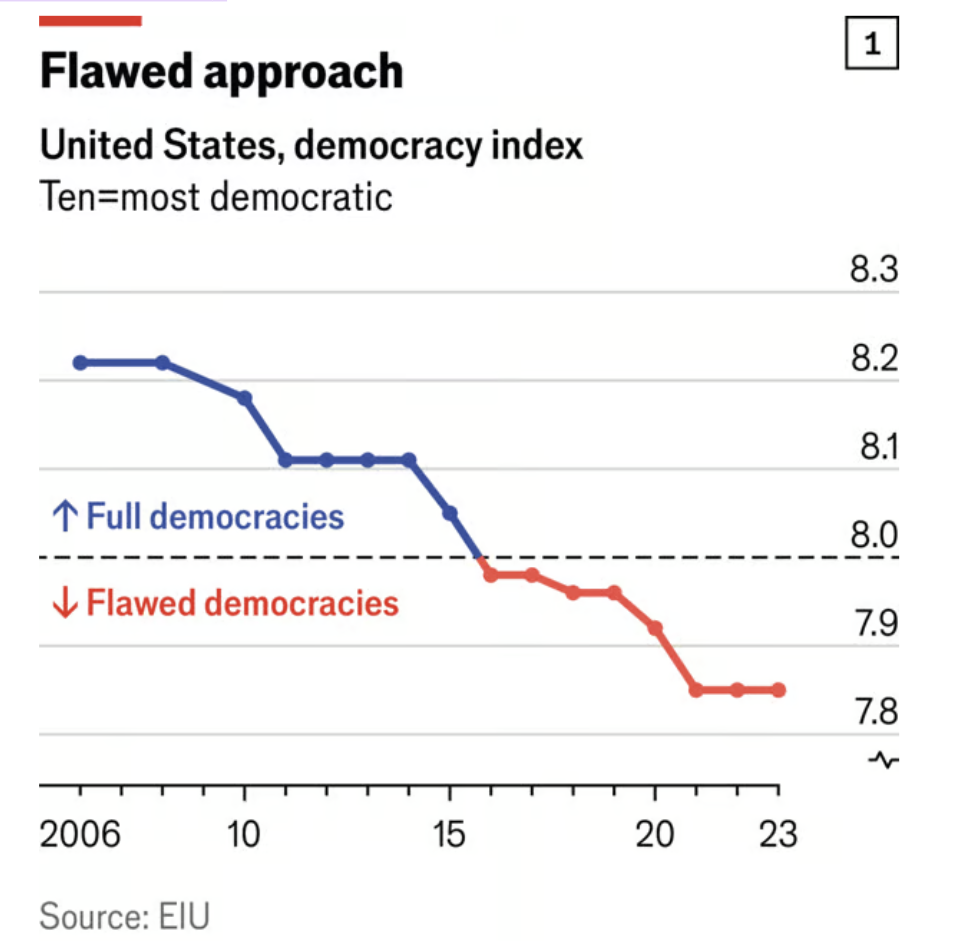
- Downgraded Democracy Indices: Since 2016, major international observers like Freedom House and the Economist Intelligence Unit (EIU) Democracy Index have downgraded the U.S. democracy status. The EIU categorizes the U.S. as a “flawed democracy” rather than a “full democracy,” citing record-low scores in political culture and government functioning.4. In the present, the U.S. ranks 34th globally due to our political polarization, low trust in government, and weakened government functioning (see Graph 1 below).
- Congressional Dysfunction: There are patterns indicating that the U.S. Congress has relinquished its power to the executive and judiciary branches, leading to a “dysfunctional” legislative environment. Basic government functions, such as passing a comprehensive budget that serves the electorate, are frequently stalled by intra-party and inter-party gridlock.
These are seven examples from the United States that illustrate a long period of political instability. In addition, income and wealth inequality are topics of significant research and concern. Recent data highlights a massive imbalance in ownership between the wealthiest and the rest of the population.
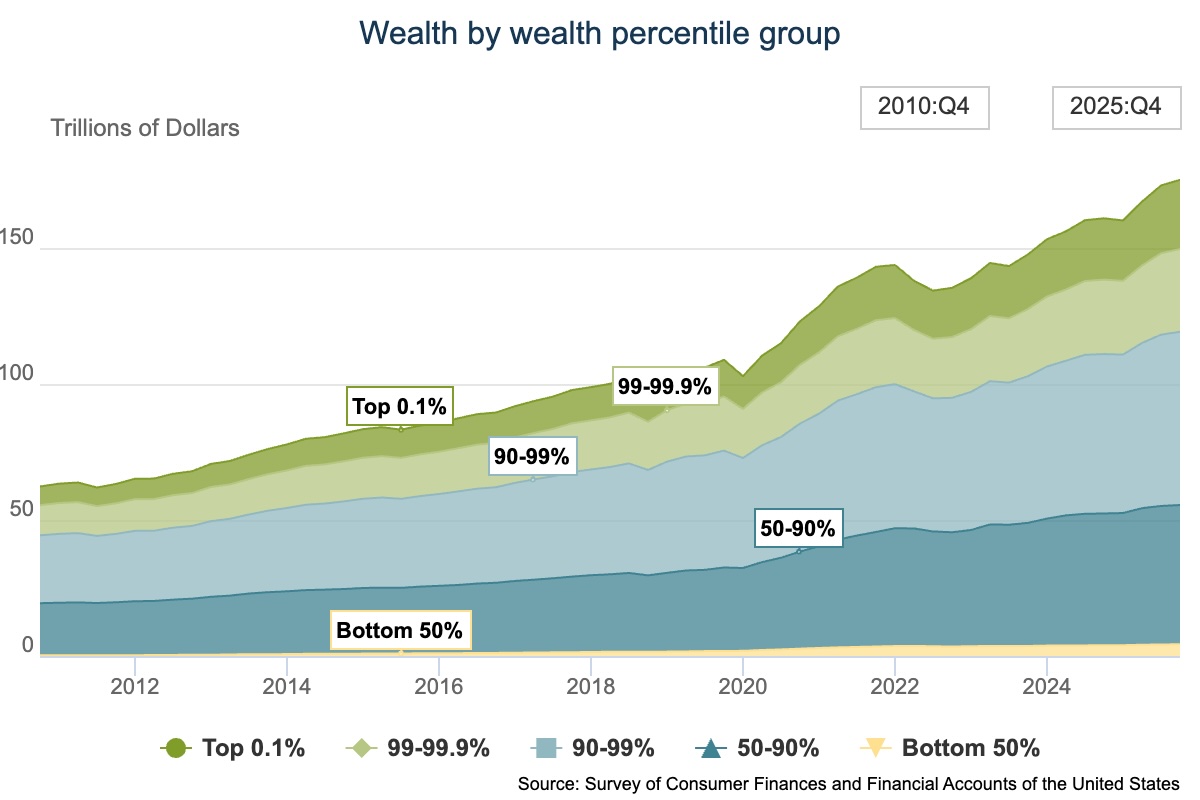
- The top 1% vs. the bottom 50%: As of the third quarter of 2025, the wealthiest 1% of U.S. households held approximately 31.7% of the nation’s total wealth. With almost 1,000 billionaires holding nearly $20 trillion of U.S. assets, the gap is widening exponentially. Graph 2 from the Federal Reserve illustrates the wealth gap that plagues our society. 5
- Total Assets: The top 1%, which includes not just billionaires, collectively held about $55 trillion, which is roughly equal to the wealth held by the bottom 90% of Americans combined.
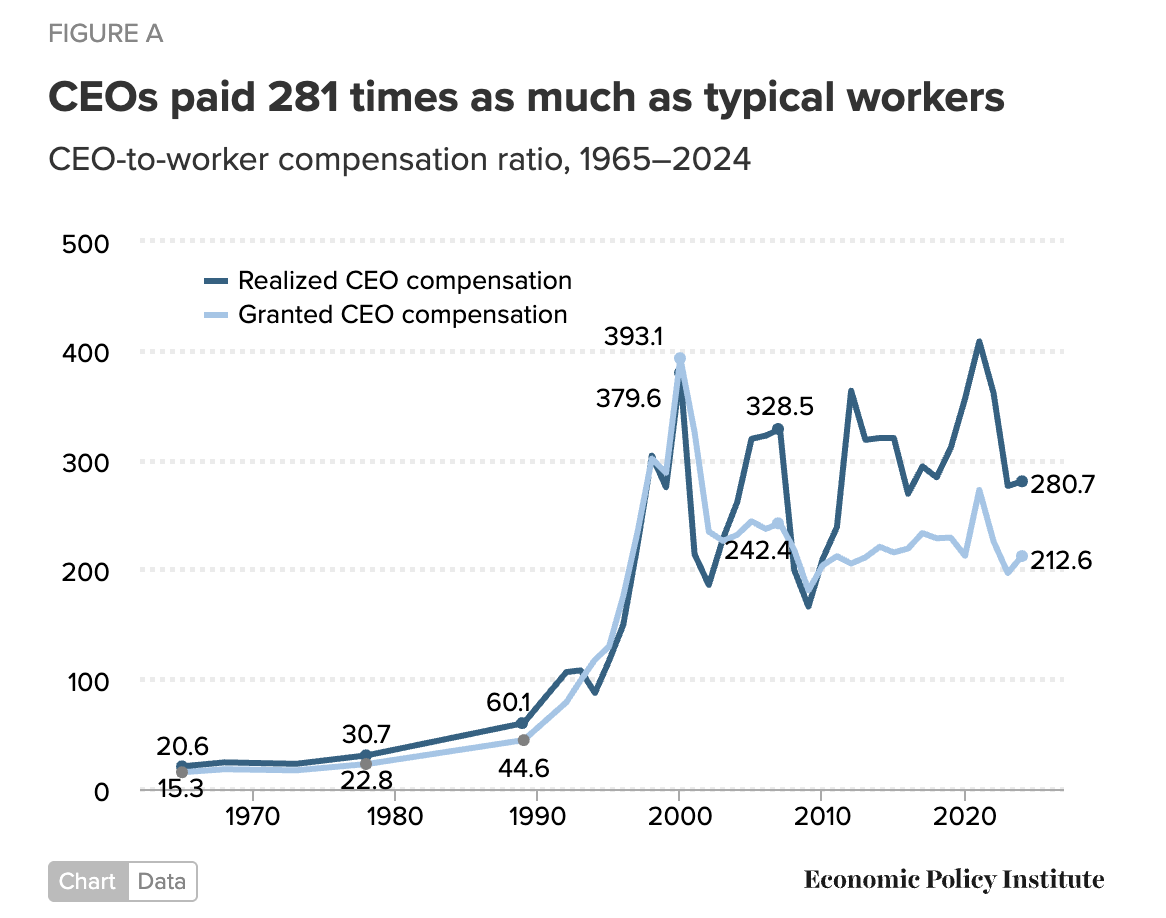
- CEO to Worker Compensation Ratio: This gap has widened dramatically over the last several decades. The Economic Policy Institute reported that since 1978, CEO compensation has increased by 1,094%, while the pay for a typical worker grew by only 26% during the same period. 6 See Graph 3 for the trend over time. Most notably, Tesla shareholders approved a record-breaking compensation package for CEO Elon Musk on November 6, 2025, valued at upwards of $1 trillion.
- According to Bankrate’s Emergency Savings Report, only 46% of U.S. adults have enough savings to cover 3 months of expenses.
From these two data sets, it seems clear why economists and political thinkers are researching the relationship between political instability and income or wealth disparity. The trajectory of increasing wealth disparity and political instability has tracked together over the past 25 years.
One of the first comprehensive studies tracking these two drivers came in 1993. Alesina et al. conducted a 1993 study of 71 countries examining the relationship between income inequality and political stability. They wrote:
Income inequality, by fueling social discontent, increases socio-political instability. The latter, by creating uncertainty in the politico-economic environment, reduces investment. As a consequence, income inequality and investment are inversely related. Since investment is a primary engine of growth, this paper identifies a channel for an inverse relationship between income inequality and growth.7
In their conclusion, they state:
Income inequality increases socio-political instability which in turn decreases investment. After an extensive battery of robustness tests, we can conclude that these results in our sample of 70 countries are quite solid.
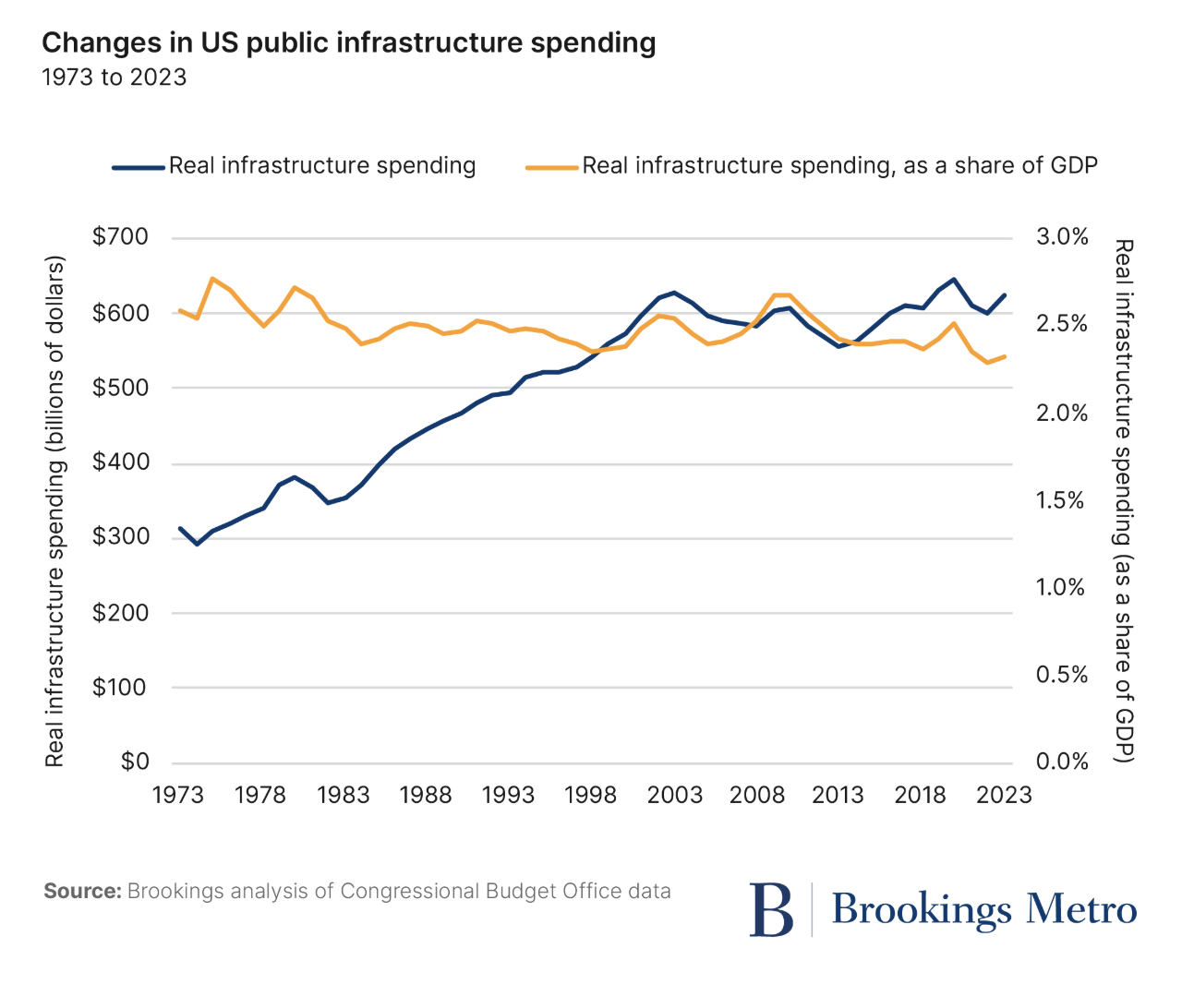
The U.S. examples outlined above undoubtedly illustrate a relationship between political instability and the overall prosperity of the population. However, it doesn’t address whether there is any loss of investment in the U.S. over time. Yet, if we look at other studies that focus on U.S. investment in essential infrastructure projects, we see trends that are discouraging. One study by the Brookings Institution points out that while total infrastructure spending has modestly increased over time, its share of the gross domestic product (GDP) continues to trend down.”8 See Graph 4 below. Political instability, as relfected in political party polarity and priorities of the Trump administration, has eroded some of the original funding expectations built into the Inflation Reduction Act (IRA). For example, investments in clean energy projects are being rolled back, as are other infrastructure projects.
The narrative Americans hear all the time, especially from politicians, is that we are exceptional, we are the wealthiest country in the world, we are the most prosperous country in the world, or we are the most innovative country. While there are truths hidden in these narratives, they are overly general platitudes. They fail to give voice to the poverty in American. As of 2024 almost 13% of Americans were living in povertry.9 Prosperous yes, but not for everyone.
Political instability reveals our shortcomings to strategically correct the factors that drive the poverty amongst us. We make progress in one area, only to have that progress derailed when new political actors come onto the stage. The political instability prevents open, honest, and productive dialogue that can lead to lasting change.
So what are we to do? While I am not a politician or an expert in these complex issues, I do know one thing. Without open and honest dialogoue built on trust, benefit-of-the doubt, and a willingness to listen for understanding we don’t have a chance of bringing the wealth gap in service of the economic inequality that exists in America. We have to simultaneously build our systems thinking muscles alongside our compassion for the suffering amongst us. These are not skills most Americans are born with or educated to acquire, so we have to work harder, breaking down barriers and building bridges. That’s the only way we truly become a prospersous country.
References:
- https://protectdemocracy.org/work/what-is-the-big-lie/ ↩︎
- https://www.justice.gov/usao-mn/pr/vance-boelter-indicted-murders-melissa-and-mark-hortman-shootings-john-and-yvette-0 ↩︎
- https://www.nytimes.com/2026/01/27/insider/minneapolis-shooting-protests-language.html?searchResultPosition=6 ↩︎
- https://www.eiu.com/n/campaigns/democracy-index-2024/ ↩︎
- https://www.federalreserve.gov/releases/z1/dataviz/dfa/distribute/chart/ ↩︎
- https://www.epi.org/publication/ceo-pay-in-2023/#fig-a ↩︎
- https://www.nber.org/system/files/working_papers/w4486/w4486.pdf ↩︎
- Brookings Institution study, March 2025 ↩︎
- 2024 Census data ↩︎
IMAGES


Leave a Reply