Confronting the Enemy Within: Healing America’s Divisions
Introduction
My recent experience watching programming to commemorate the 25th anniversary of the 9/11 tragedy led me to wonder about the “enemy outside” versus the “enemy within” us. While we experience temporary solidarity and collective grief upon remembering the victims of the 9/11 terrorist attack in the U.S., our society and the political parties that comprise our government are flooded with persistent and paralyzing domestic discord. We struggle to respect and get along with one another, and therefore make little progress meeting the needs of “average” Americans.
Why do societies readily unite against perceived external existential threats, enemies like “terrorists,” yet remain deeply fractured by internal, structural crises like climate change, healthcare access, or caring for the vulnerable? Why do we struggle to work together to solve complex problems for the common good?
Our heavy reliance on the “enemy archetype” to forge social cohesion leaves our democracy ill-equipped to address systemic challenges, forcing a shift from externalized antagonism toward confronting the complex “enemy within.” We have an aversion to looking in the mirror and seeing the enemy
The External “Other”
Evolutionary Tribalism: One characteristic of being human is our tendency to align ourselves with people who think, believe, or act like us. Finding a community or “tribe” that mirrors your values is a fundamental human drive rooted in our need for belonging, safety, and shared understanding. Some would call this tendency to distinguish between the in-group and out-group a survival necessity. We feel comfortable in our tribes.
The Power of a Crisis: When we experience a shared external danger, like a hurricane or deadly flood, it has the proclivity to collapse political, economic, and social boundaries we construct in our tribes. During the 9/11 crisis, we saw politicians from both sides of the aisle holding hands in solidarity. Their unity in the face of an existential crisis was vital for us to begin the response and recovery from the devastation.
Moral Clarity: Our society needs to construct moral clarity regarding how we navigate complex, multifaceted systems that require teamwork and consensus building to achieve solutions for the common good. The simplicity of a binary moral universe, good versus evil, us versus them, or left versus right, has frustrated our attempts to solve complex systems or policy dilemmas.
The Failure of Cohesion Without an Antagonist
Abstract Crises: Why do some issues lacking a clear enemy—such as carbon emissions, preventive healthcare, or wealth inequality—fail to trigger an acute fight-or-flight solidarity response? The lack of a villain requires us to dig deeper to find common ground. There isn’t anyone we can immediately agree to blame for the problem at hand. Therefore, we have to tease out the nuances of our positions, discuss our differences, listen with an open mind, and use trial and error to test solutions. This process is more laborious, requires patience, and demands consensus building. These are qualities humans struggle to develop and use to solve complex problems.
In order to address an abstract crisis with creativity and curiosity, we must be willing to collaborate for the common good, putting our self-interests on the back burner.
Politicization of the Neutral: There is a tendency for humans to manufacture artificial enemies when a real enemy doesn’t exist. For example, during the COVID pandemic in 2020, when we couldn’t find an obvious “enemy,” the U.S. placed the blame on China. President Donald Trump defended his use of the terms “Chinese virus” and “China virus” in March 2020, stating that the label was accurate because the virus originated in Wuhan, China. While the statement about its origin was true, labeling the virus “China virus” projected blame where it didn’t belong. The virus, SARS-CoV-2, is not the China virus. It is a naturally occurring virus found in bats. The tendency to manufacture artificial enemies when real ones are absent (e.g., turning public health measures or scientific data into cultural battlegrounds) is rampant in our polarized political culture.
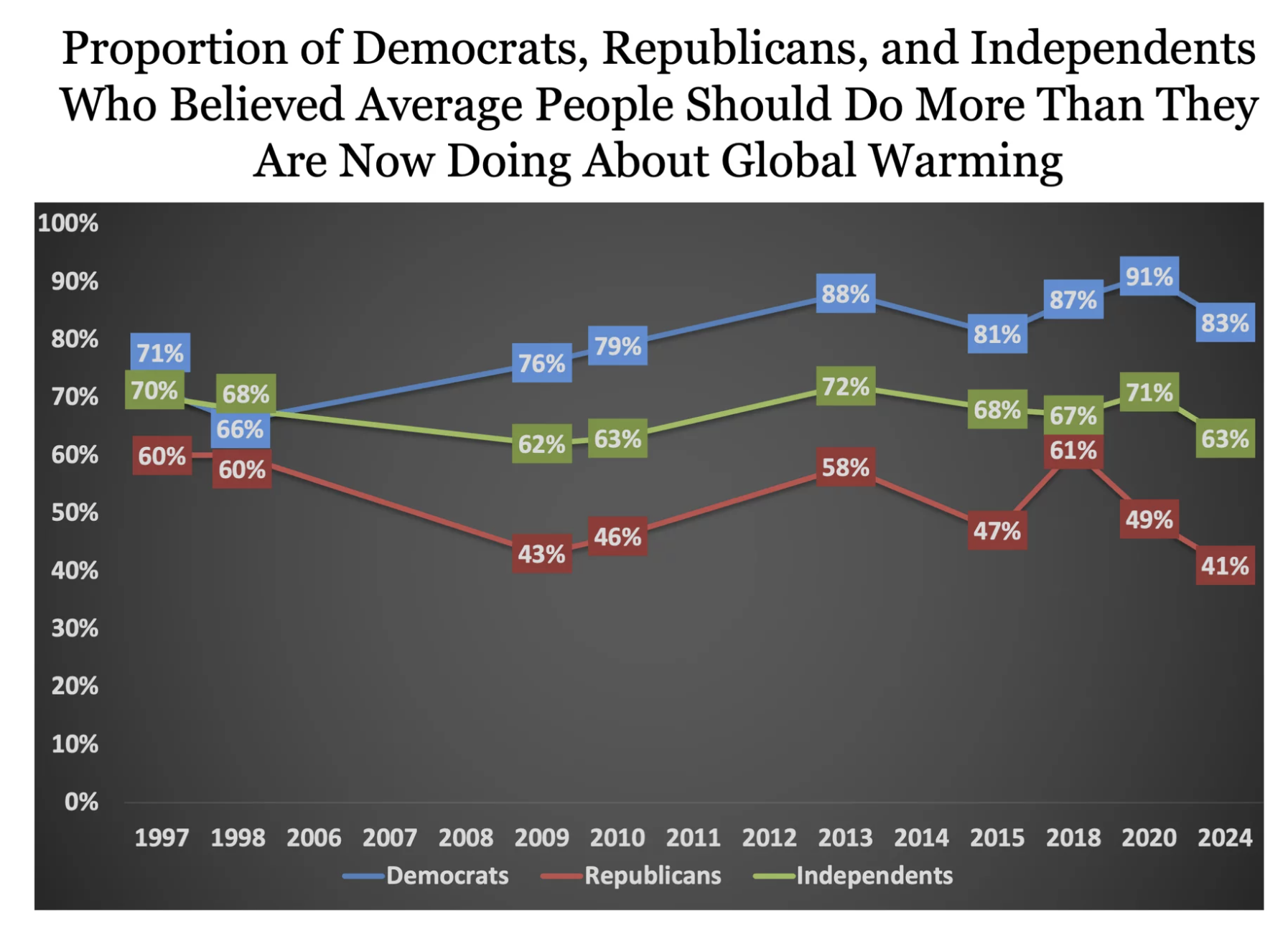
Diffusion of Responsibility: As we see with climate change, when everyone is part of the system causing the problem, few people step up to take responsibility for solving it. Consequently, the American public remains divided on whether climate change is real. A report from Stanford University, American Public Opinion on Global Warming, writes:
“…in 2024, only 43% of Republicans believed the world’s temperature has been increasing over the past 100 years. 88% of Democrats believed that the world’s temperature has been increasing over the past 100 years, leading to a partisan difference of 45 percentage points (see Graph 1).1
Graph 1
This polarization causes political parties to dig in their heels and struggle to address the problem to everyone’s benefit.
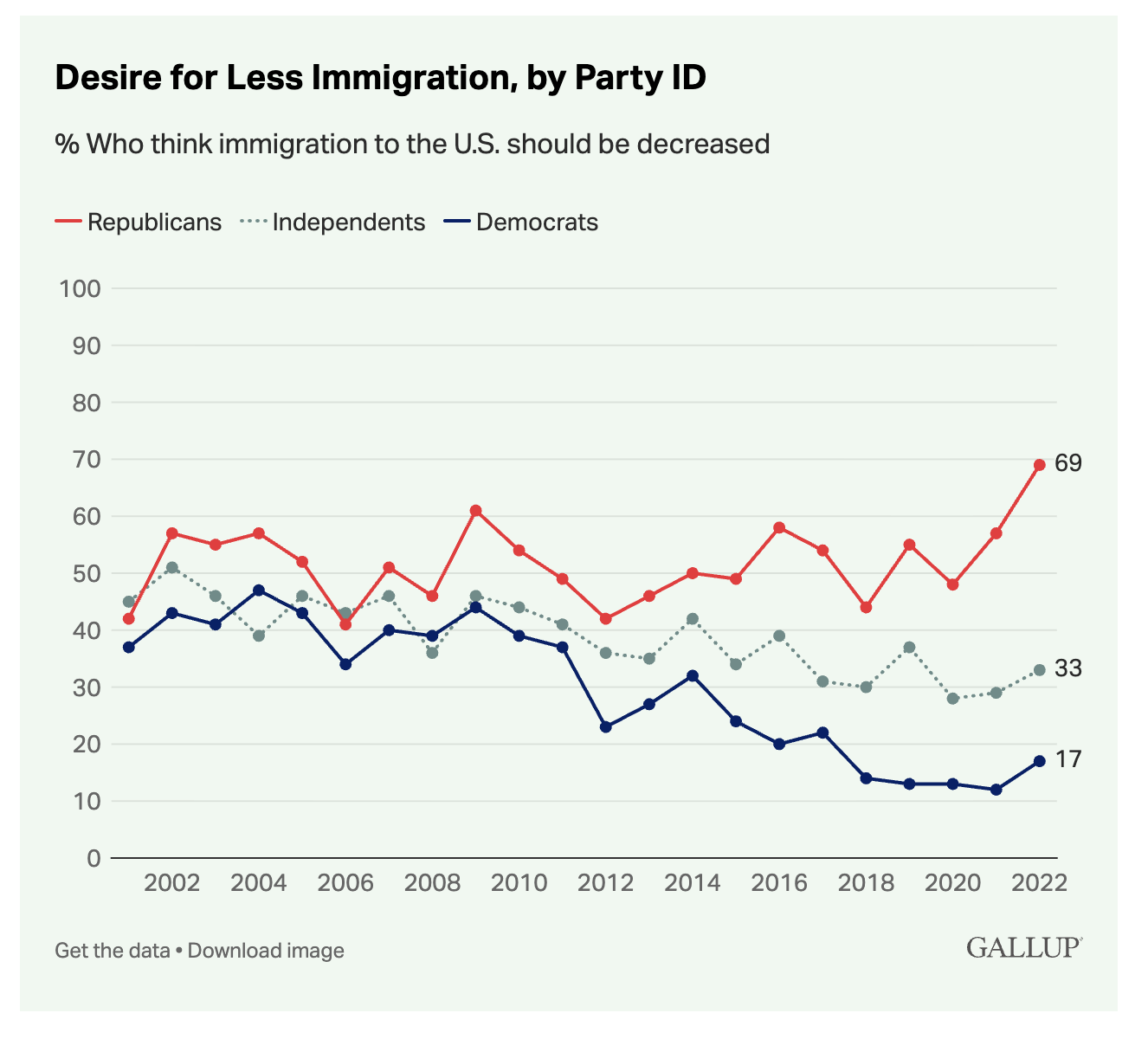
Another example of the diffusion of responsibility arises when we try to foster a comprehensive nationwide immigration policy. The United States has pursued comprehensive immigration reform for the last 40 years. It began with the passage of the Immigration Reform and Control Act of 1986 (IRCA) under Ronald Reagan. However, since that time, little has been achieved other than casting blame on the other party, and it remains a contentious issue. A Gallup poll in 2022 found that 66% of Republicans wanted a decrease in immigration to the U.S., as compared to only 17% of Democrats (see Graph 2).2
Graph 2
Challenges we face in our society will not get addressed unless parties, religious groups, social groups, and ordinary citizens accept responsibility for their views and behaviors. Recognizing how rigid views and behaviors divide the country and promote the enemy archetype.
Projection and the Shadow (The Enemy Within)
Jungian Depth Psychology: While I am not a Jungian expert, his concept of the shadow in the human psyche aligns with the “enemy within” idea. Projecting collective shadow elements, such as fear, aggression, failure, or violence, onto external scapegoats to preserve one’s self-image often leads to an us-versus-them mentality. We perceive the other as an enemy, but the enemy might be inside of us.
The Unexamined Life: When we demonize the other and fail to look in the mirror, we lead an unexamined life. Parker Palmer’s reflection on Socrates’ saying—”the unexamined life is not worth living”— emphasizes that self-awareness is crucial to living with integrity and avoiding harm to others3. There appears to be greater comfort fighting a visible adversary, as opposed to transforming ourselves, restructuring systems, confronting historical conspiracies, or redefining national identity. We remain entrenched in demonizing the other.
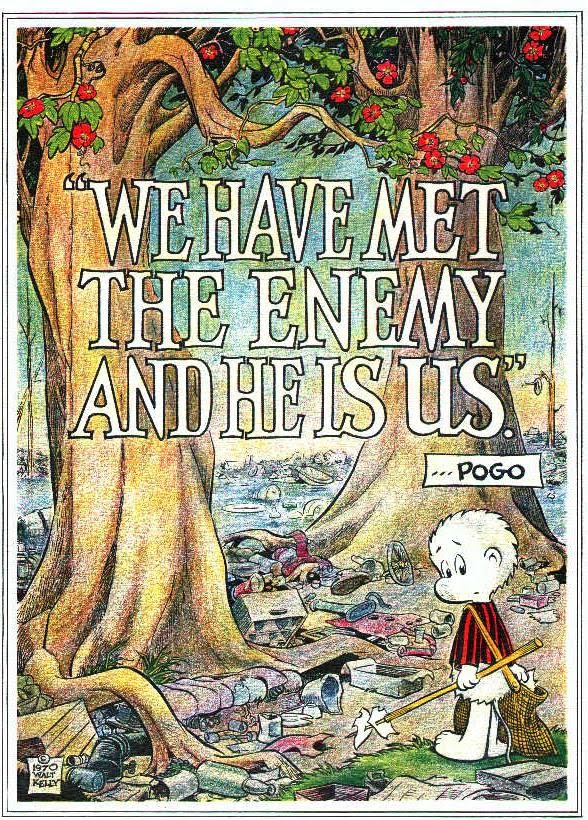
Ecological and Social Realities: We also struggle with the reality that climate change or public health crises are direct mirrors of domestic extraction, consumption, and structural neglect. In 1970, the cartoonist Walt Kelly created a poster for Earth Day that said, “We have met the enemy, and he is us.”
National Air & Space Museum, Smithsonian Institution
Toward a New Archetype of Unity
Common Good: We have to ask more difficult questions about what policies, actions, and behaviors advance the common good. If we can move beyond polarizing or hostile politics to build solidarity around oversight rather than opposition, we have a chance at solving society’s most puzzling issues. If we act in service of the common good rather than self-serving interests, then we might avoid seeing the enemy in others.
Civic Pride and Collective Responsibility: We must elect politicians guided by a devotion to cultivating civic cohesion through long-term nation-building, ecological restoration, and mutual aid rather than militarized defense. As a society, we will contribute more to the common good if we support organizations like USAID, the United Nations, and other peace-oriented entities. It is incumbent upon all citizens to engage in restorative practices at the local, regional, and national level. Assuming collective responsibility for our actions and behaviors might promote living an “undivided life” that avoids demonizing the other.
Conclusion: For our own survival, designing the transition from an enemy to a mentor archetype might give us a fighting chance to heal the injuries we cause one another. This transition will help us unite not just against a threat, but for a sustainable human future.



Leave a comment