
Amidst all the ruckus in the Presidential race, we hear very little about education from either candidate. While President Biden has advanced some policies that support American education, his administration hasn’t done enough to move the needle on United State’s ranking in education. Former President Donald Trump rarely talks about education, explaining his philosophy or policy positions. His behavior and speeches would indicate that he’s more concerned about pumping up culture wars rather than advancing a teaching and learning agenda focused on educational opportunities for all students. Americans need a better understanding of each candidates’ vision for education because our future depends on it.
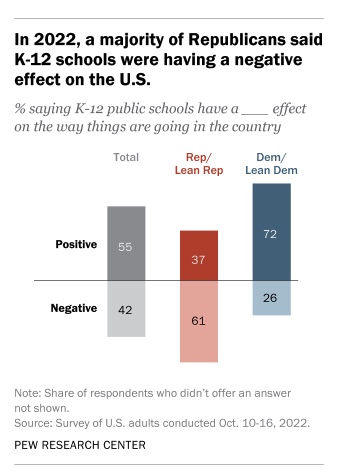
The data from a report sponsored by the Pew Research Center, Partisan divides over K-12 education in 8 charts, offers insights into the differences between the approach of each political party. (See the graph below). 72% of Democrats believe K-12 public schools are having a positive impact on American society, while 61% of Republicans believe it is having a negative effect (GRAPH 1). These profound differences in attitudes will likely impact whether a political party advances a teaching and learning agenda versus a culture war agenda. Reclaiming our status as one of the best countries for education will require a thoughtful teaching and learning agenda not a culture war agenda.
We spent almost 200 billion in pandemic aid to support schools, but nationally, achievement scores over that period of time increased modestly. We did little to invest in the education of birth to 4 year olds during the pandemic, and those children, now entering pre-K, appear to be behind in their developmental growth (Miller and Mervosh, 2024). According to Data Panda, a site that aggregates and presents data in a variety of topics, the United States ranks 13th in the world in education, lagging behind many developed countries, even though we spent much more on education.
In 2023, students in the US improved their ranking on the PISA test (Program for International Student Assessment); however, their overall scores did not improve relative to 2018. “In math, the U.S. rose from 29th place to 28th place, still in the bottom half of economically-advanced nations of the Organization for Economic Cooperation and Development (OECD), an international organization of 38 member countries that oversees the PISA exam.” (Jill Barshay, FutureEd, December 2023) This modest change in ranking was accompanied by a 13 point drop in math scores relative to 2018, a change that translates into a loss of almost 2/3 of a year of math education. While these slight improvements are noteworthy, the enormous investment in support for students during the pandemic should have yielded stronger outcomes. Where did we go wrong?
The other concern is that the gap between students from advantaged versus disadvantaged environments is widening due to the added support students from advantaged backgrounds receive, especially during the pandemic. The New York Times article, The Youngest Pandemic Children Are Now in School, and Struggling, suggests that these children entering pre-K are: “showing signs of being academically and developmentally behind.” This situation appears to be brought on by a variety of factors including, having to wear masks, not interacting with adults to the same degree, and not being able to play with peers due to social distancing. We severed many opportunities for interactions, something young children crave as part of their social development. A troubling trend that researchers are seeing is: “Children at schools that are mostly Black or Hispanic or where most families have lower incomes are the most behind (Student Growth in the Post-COVID Era, Curriculum Associates, 2024).
Questions we face right now are: (1) will school districts around the country have the leadership in place to understand the complex challenges we face and address them; (2) since we did not invest resources in non-school aged children during the pandemic, will administrators be able to pivot, scaling up additional support for pre-K; and finally, (3) are early childhood educators equipped to address the social-emotional, physical, and cognitive needs of children who are now entering pre-K unprepared?
It all starts with our youngest students. We need to rebalance our priorities from investing taxpayer resources into K-12 education and funnel more resources into programs supporting birth to 4 year olds. The Center for American Progress analzyed the 2024 State of the State addresses and found that about 70% nation’s governors highlighted child care and/or pre-kindergarten (Anne Lovejoy). There is a ground swell of support for universal early childhood education. While children from well-to-do families have resources and options, economically struggling families need state or federal support. A federal and state partnership to provide universal early childhood education would be an investment for the future.
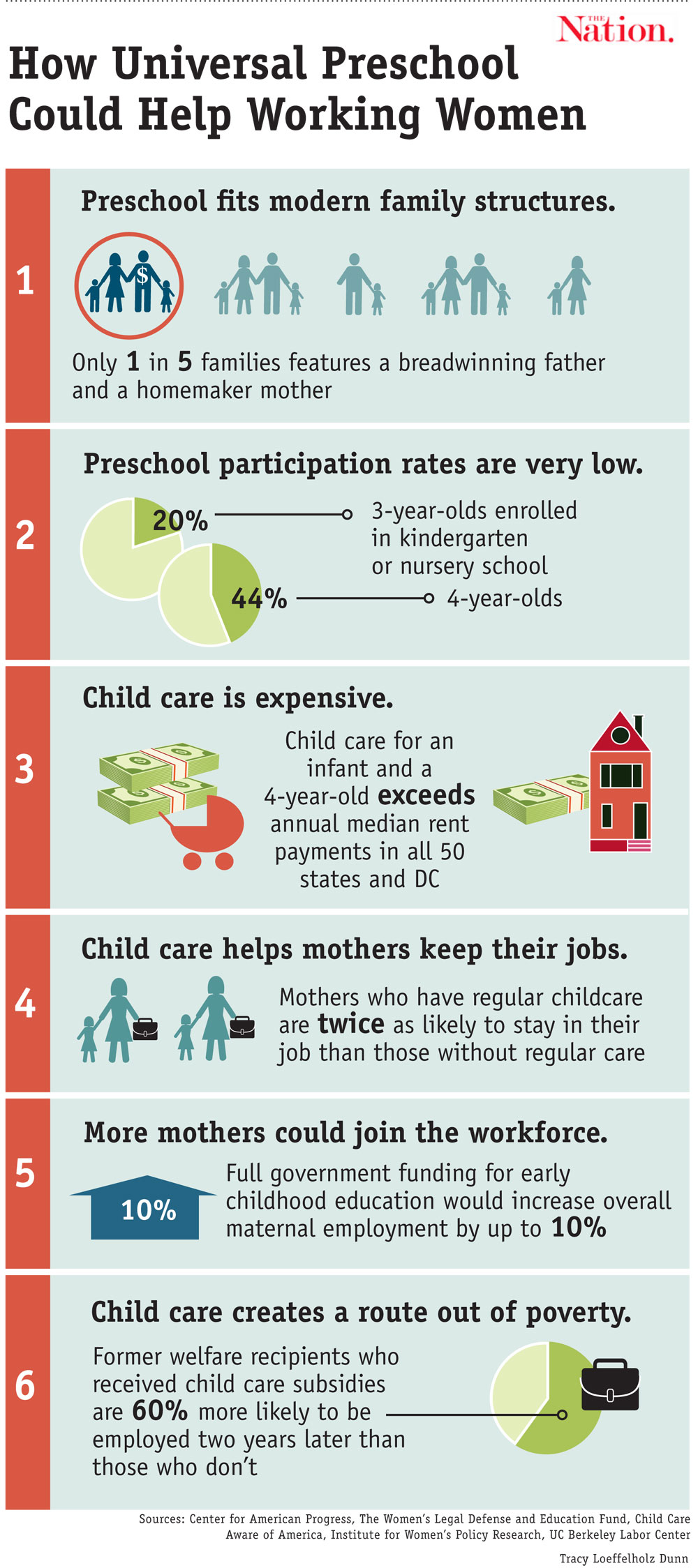
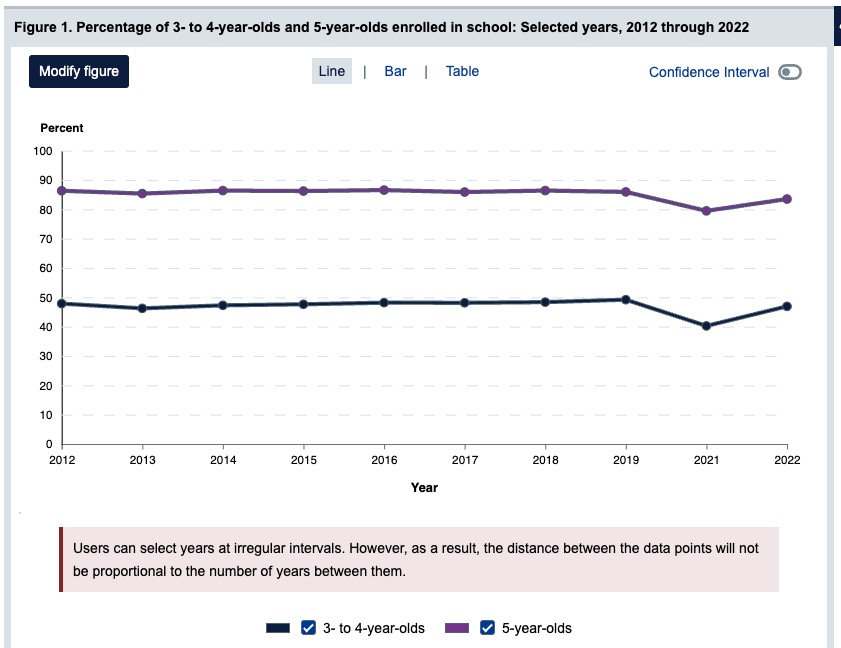
Back in 2013, Bryce Covert wrote a piece In the Nation and included an infographic highlighting six reasons why universal early childhood education is necessary (see below). These six reasons are very relevant 11 years later, especially for parents from families that struggle economically. Since only about 40% of 3-year olds in America attend a program, we have not made significant progress over the 11 year period. GRAPH 2 clearly illustrates that school enrollment for children younger than 5 has not changed much since 2012.
Equity in educational opportunities for all children starts with the recognition that investing early pays huge dividends for the future. The United States will elevate its educational standing in the world if we make some courageous moves to prepare all children for an increasingly complex and global future.
References:
Claire Cain Miller and Sarah Mervosh, The Youngest Pandemic Children Are Now in School, and Struggling, New York Times, July 1, 2024.
Jill Barshay, What the New PISA Results Really Say About U.S. Schools, FutureEd, December 2023.
Jenn Hatfield, Partisan divides over K-12 education in 8 charts, Pew Research Center, June 5, 2023.
Curriculum Associates, Student Growth is a Post-COVID Era, 2024.
Anne Lovejoy, Governors Are Calling for Investments in Early Care and Education, Center for American Progress, 2024.
Bryce Covert, INFOGRAPHIC: How Universal Preschool Is an Economic Boon to Working Mothers, Nation, 2013
National Center for Educational Statistics, School Enrollment Rates of Young Children, May 2024.


Leave a comment