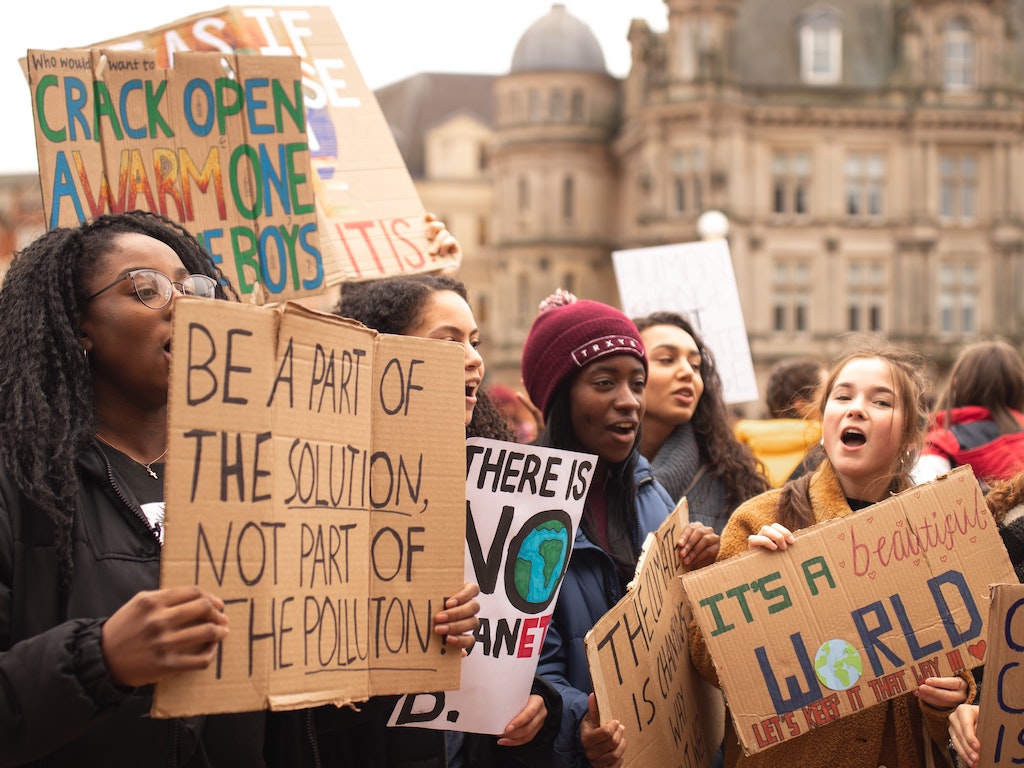
As a society, do we care about the long-term mental health of future generations? If the answer is no, then we can move forward with climate antagonistic energy and food systems policies. If the answer is yes, then we have an obligation to understand and responsibly manage energy and food systems that impact global warming.
Eco-anxiety, sometimes referred to as climate anxiety, is of heighten concern. Most recently, the concern has focused on its affects on young people, impacting their psychological well-being.1 Eco-anxiety describes the fear of environmental ruin that accompanies the crises we experience almost daily. A central theme that arises in eco-anxiety is that our society is on the precipice of a collapse.2
Here’s are some facts that we must come to grips with regarding eco-anxieties impact on our younger generations‘ health and wellness. First, studies and polls commonly show a high-level of distress about climate change among youth.3 A 2021 study of 10,000 young people from 10 different countries reported in Lancet found that about 60% were very worried about climate change. Additionally, 85% were at least moderately concerned.4
Second, more than 45% of the young people surveyed in the Lancet study reported their feelings about climate change adversely impacted their daily functioning. This can manifest as difficulty sleeping, concentrating in school, or enjoying aspects of life.
Third, eco-anxiety in young people manifests itself with a range of emotions, including:
- Anxiety (reported by 62% in the Lancet study)
- Fear (67%)5
- Sadness (67%)6
- Helplessness (51%)
- Anger (57%)
- Guilt and shame
- “A heavy emotional burden” like hopelessness and a sense of betrayal7
Young people express fear about their future.
Three-quarters (76%) said the future is frightening. Climate change weighs on future life decisions such as where to live (69%) and whether to have children (52%).8
Many young people express the concern that adults have neglected climate change phenomena. They fear that the problem is being left to younger generations to address. These unaddressed concerns can create additional anger, betrayal, and abandonment.9 When children experience abandonment, they can face psychological challenges that have lasting effects. Adults must take positive steps towards assuring younger generations that we care. I believe that our primary responsibility is to be accountable for worldwide system change related to stabilizing Earth’s climate.
In the US, we saw the devastating impact of 2024 flooding in Asheville, NC from Hurricane Helene. Asheville’s young people, who experienced this severe weather event, saw loved ones parish and their entire community traumatized. They were without the support of schools for over a month and recovery efforts politicized furthering a sense of abandonment. Recovery has been slow and painful. A study from New York University found that youth and young adults want to talk about climate-related distress. They also want action.10
Direct exposure to a climate change event is not a necessary prerequisite to create psychological distress. Even without direct experience, climate change information through persistent media coverage can evoke negative emotions that impact daily functioning.
Adolescents are particularly vulnerable to the mental health consequences of climate change. This is due to their ongoing biological, psychological, and social changes. An adolescent’s brain is more sensitive to rewards, feedback and stress compared to an adult brain. Their enhanced sensitivity results from more neurological development in the emotional and social regions of their brains.23
Climate change impacts can indirectly affect mental health. This occurs through physical harm caused by excessive heat.11 Air and water pollution that accompanies global warming also play a role. Changes in the food supply arising from prolonged droughts can impact mental health by disrupting vital supply chains. With global warming, there is an increased risk of infectious diseases as human behavior patterns adapt. For example, the spread of infectious diseases from mosquito and tick-borne viruses can become widespread.12
What are ways we can support future generations?
It’s important for adults to affirm young people’s feelings regarding climate change rather than ignoring them. We have to help our young people understand and cope with their current reality. In addition, we must rebuild their trust in our willingness to seriously address global warming. They are watching and learning from our actions or non-actions.
Engaging in pro-environmental actions can help them channel their despair into a sense of agency and control. Actions adults can take are activism, volunteering, or making sustainable lifestyle choices regarding energy use and dietary accommodations.13 Some research points to the positive effects activism can have on young people’s eco-anxiety and depression.14
Helping young people identify what they can control can reduce a feeling of helplessness. It also helps them understand those things that are beyond their control. Think and act locally versus globally as a start to taking action. For example, what behaviors or practices can I change right now that will be a first step.
Encouraging our young people to spend time in nature can help them see its beauty and appreciate its complexity. There is some research that points to the positive impact on mental health when we spend more time in nature.15
If eco-anxiety interferes with sleep, appetite, academic performance, or social interactions, seek support from a climate-aware therapist. Consulting a mental health professional can be a course of action.
Conclusion
Eco-anxiety is a growing challenge for young people’s psychological well-being. Adults must embrace this challenge wholeheartedly and work towards positive solutions for the health of young people and our environment. Young peoples’ mental health manifests in a range of distressing emotions, such as depression. It also impacts their ability to respond to daily challenges. Understanding these impacts is critical for our society. Adults must provide a supportive environment, at home and school, that encourages open, honest communication. We should encourage or empower action to foster hope that all is not lost. Adult involvement is crucial now. Young people also need the aptitude to handle these complex issues in the future. It’s important they have the right sensitivity and disposition to succeed.
Links to references
- https://www.apa.org/monitor/2025/06/youth-climate-anxiety-action ↩︎
- https://www.apa.org/monitor/2021/03/ce-climate-change ↩︎
- https://www.pnas.org/doi/10.1073/pnas.2311400122#:~:text=While%20the%20United%20States%20is,many%20US%20youth%20are%20struggling ↩︎
- https://pubmed.ncbi.nlm.nih.gov/34895496/ ↩︎
- https://time.com/7280989/climate-anxiety-mental-health-young-people/ ↩︎
- https://www.frontiersin.org/journals/climate/articles/10.3389/fclim.2021.738154/full ↩︎
- https://e360.yale.edu/features/for-gen-z-climate-change-is-a-heavy-emotional-burden ↩︎
- https://www.usnews.com/news/health-news/articles/2024-10-21/most-young-americans-worry-about-climate-change-survey-finds#:~:text=More%20than%2060%25%20say%20climate,fix%20what%20they%20have%20broken. ↩︎
- https://www.medrxiv.org/content/10.1101/2023.12.19.23300198v1.full ↩︎
- https://www.psychiatry.org/news-room/apa-blogs/youth-perspectives-on-climate-change#:~:text=Those%20who%20had%20experienced%20exposure,distress%20and%20desire%20and%20plans ↩︎
- https://www.gov.uk/guidance/heat-summary-health-effects-of-climate-change-hecc-full-report#:~:text=prolonged%20heat%20causes%20long%2Dterm,physical%20and%20mental%20health%20issues ↩︎
- https://health.ucdavis.edu/news/headlines/experts-warn-climate-change-will-fuel-spread-of-infectious-diseases-/2024/03#:~:text=Changing%20rain%20patterns%20are%20expanding,George%20Thompson%2C%20infectious%20diseases%20specialist ↩︎
- https://ysph.yale.edu/news-article/collective-action-helps-young-adults-deal-with-climate-change-anxiety/ ↩︎
- https://climatecommunication.yale.edu/publications/distress-about-climate-change-and-climate-action/#:~:text=In%20turn%2C%20taking%20action%2C%20especially,people%20overcome%20their%20negative%20emotions. ↩︎
- https://www.mentalhealth.org.uk/our-work/research/nature-how-connecting-nature-benefits-our-mental-health#:~:text=Connecting%20with%20nature%20is%20critical,from%20%E2%80%9Chigh%20quality%E2%80%9D%20nature%20spaces ↩︎
 rryshke.org
Leave a comment