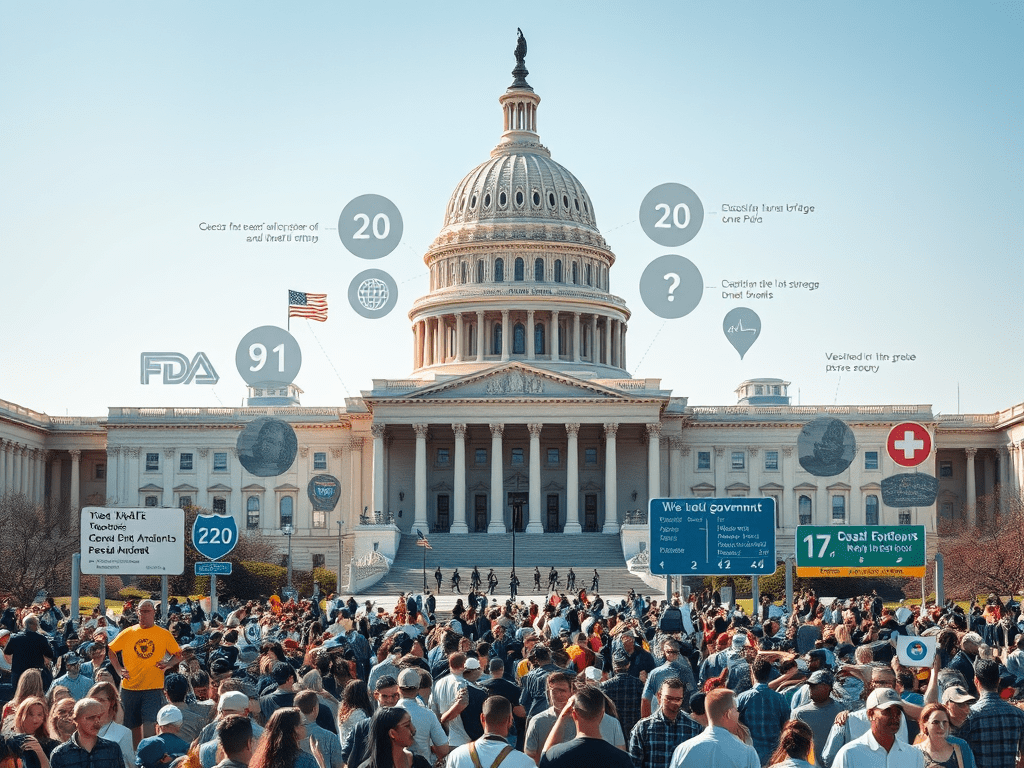
Politicians, mainly conservatives, advocate for smaller federal government. However, they fail to understand that government’s inherent complexity demands a robust and transparent structure. Robust doesn’t mean tough or powerful, it means full-bodied and up to the task of effectively serving all Americans. Transparent means free of deceit, operating with humility. The combination results in a government that cares about society’s needs and structures itself accordingly to meet the challenges.
Let me present a case for our federal government’s complexity. This idea is rarely amplified in public forums. I will use readily available data.
- United States has 340 million diverse people
- 59 metropolitan areas in the US are over 1 million people
- In 2023, the Social Security Administration provided benefits to nearly 71 million people
- As of 2024, a total of 79 million people were enrolled in Medicaid and CHIP (child health insurance program).
- Our interstate highway system spans about 47,000 miles which is twice around the Earth
- there nearly 55,000 bridges on our interstate system many of which were built before 1969.
- The Federal government owns and manages 650 million acres of land.
- About 85 million acres is managed by the National Park Service
- The US military employs almost 3 million people, with 1.3 million being in active duty.
- The budget is about 850 million.
- US maintains about 800 military bases in more than 70 countries and territories
- We have a plethora of complex agencies that oversee important programs serving our 50 states.
- Federal Drug Administration
- Occupational Health and Safety Administration
- National Institutes of Health
- National Cancer Institute
- U.S. Environmental Protection Agency (EPA) and Office for Coastal Management, a part of National Oceanic and Atmospheric Administration (NOAA)
- Many Others
- Each agency has a budget, employees, and serves our country in countless ways
- On any given day, there are approximately 5,400 airplanes in the air over the US at any time. The 45,000 employees of the FAA, which includes air traffic controllers, keep our skies safe.
- Approximately 137,000 federal law enforcement officers are authorized to make arrests and/or carry firearms in the US. This includes around 49% who work for the Department of Homeland Security and 30% for the Department of Justice.
- Federal courts recorded about 275,000 civil cases and 75,000 criminal cases. Bankruptcy courts registered 380,000 new case filings in 2022. The Supreme Court received 4,900 petitions in 2021.
- The Federal Bureau of Prisons (BOP) employs around 35,850 people.
- The number of inmates in federal prisons in 2023 was approximately 155,972.
The above list is a sample of data that illustrates how complex the US federal government is. Something we rarely discuss as loud voices advocate for cutting government. Our federal government’s annual budget of almost 6.8 trillion dollars is used to support the well being of 340 million US citizens. That’s the government’s primary responsibility. And remember, this doesn’t include 50 state governments that have their own layer of complexity. We need a robust and transparent federal government to support America.
Why do conservatives advocate for “smaller government?” Because governments are inefficient and wasteful. Because “pulling yourself up by your boot straps” is healthier than being dependent. Because power tends to corrupt. Speaker Mike Johnson defines the second of seven core principles of conservatism this way:
We believe, as our founders did, that legitimate government operates only by the consent of the governed, and is more efficient and less corrupt when it is limited in its size and scope.1
How do we meet the needs of a diverse population of 340 million? Government, “limited in size and scope,” is not the answer. Smaller government has been conservatives’ maxim for many years. People like Mike Johnson redirect our focus. This diverts us from understanding why we need a larger government to manage our complexity effectively. Our current system is designed to meet the growing needs of a diverse and complex society. For government to work effectively we need two things. First, sufficient investment in all parts of the whole. Second, a careful, strategic, and surgical approach to enhance government’s efficiency.
Go back in time. Look at the Love Canal disaster as one example. It shows why we need a robust and transparent government. Love Canal was a significant environmental disaster resulting in the creation of the US Superfund program. The canal, an abandoned project in Niagara Falls, New York, was a dumping ground for Hooker Chemical Company’s industrial waste. The contaminated site leaked dangerous chemicals into the ground water in surrounding neighborhoods. Hundreds of families were evacuated. This incident led to the Comprehensive Environmental Response, Compensation, and Liability Act (CERCLA). This act created the Superfund administered by the EPA to clean up toxic sites around the US. A vital initiative for the health of millions of Americans.

Inefficiencies exist in a system as complex and vast as our federal government. Making changes to increase efficiency is a prudent thing to do. However, it makes most sense to accomplish this with surgical precision, not with a sledge hammer. DOGE, Department of Government Efficiency, appears to be taking the sledge hammer approach. It’s creating undo chaos and uncertainty because it appears to lack a coherent and measured strategy for change. If DOGE had been around in 1982, it might have cut funding for the Superfund. This fund was crucial for cleaning up toxic sites around the US.
I offer this brief essay. It is supported by a list of data. This shows that moving from a complex system to a simpler one is unreasonable in just months or years. For a government to serve its citizens well, it needs an infrastructure of qualified people. It requires resources to fulfill its myriad of responsibilities. Our mantra should not be to create “smaller government.” Instead, we should create a more robust and transparent government. This government should be designed to meet the needs of a diverse and vibrant society.
This is what I believe we need in America. First, a just and equitable structure for creating revenue for our government. Corporations and wealthy people need to pay their fair share without loopholes. Second, design an ongoing, comprehensive, reliable, and transparent system for examining our government’s efficiency. Third, continue investment in programs that address our society’s vital needs, and design new programs to meet anticipated future needs.
What are your thoughts about this idea of a smaller versus larger government?
 rryshke.org
Leave a comment