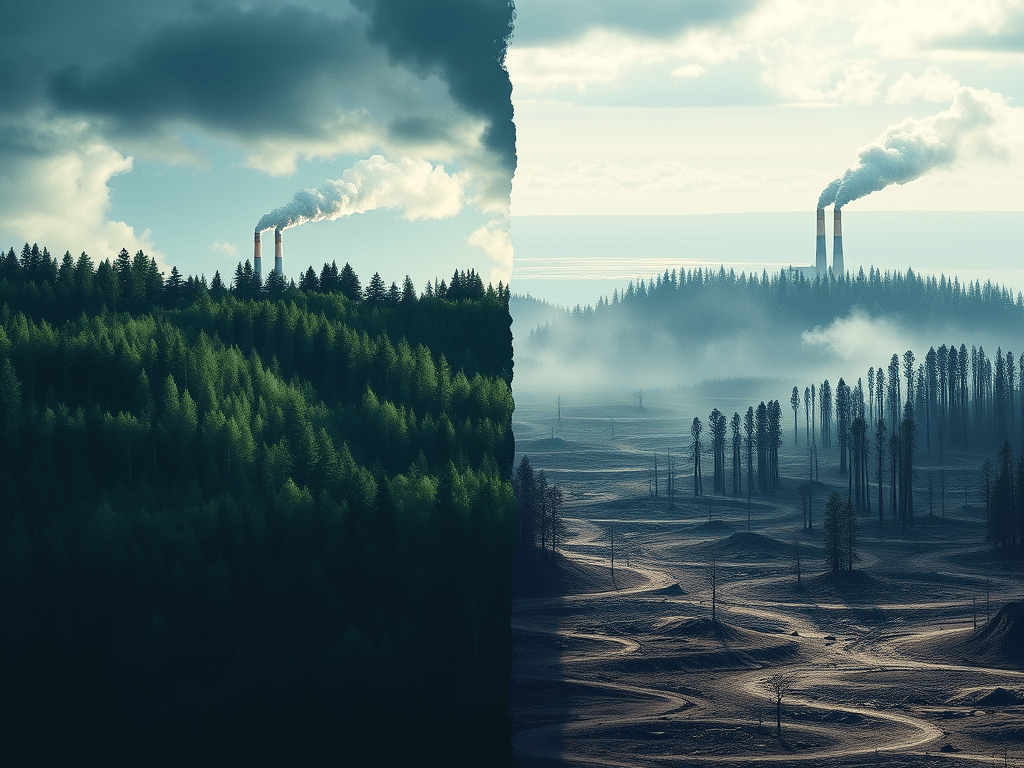
As world citizens, we have a duty to engage with this important question.
What is our individual and collective responsibility to combat the human impact of climate change?
I am currently reading David McLaren’s book, Wisdom and Courage for a World Falling Apart: Life After Doom. McLaren clarifies in vivid detail the impending challenges we face as human beings on planet Earth. After each chapter he integrates questions and journaling activities for the reader to process the content and ideas. For me, working with his questions is the first step in taking individual responsibility for “life after doom.” My hope is that you will feel the same after reading this.
Before moving forward with some reflections on Life After Doom, let me lay out some facts about climate change. I feel compelled to make a list because climate change deniers create “alternate facts” that misrepresent the well-known science. Please read through the facts and spend time doing your own research to validate mine if you don’t agree.
- Burning fossil fuels for electricity, heat, and transportation is the largest contributor to greenhouse gas emissions, accounting for over ~75% of global emissions and ~90% of carbon dioxide emissions. (reference)
- Deforestation is a problem because trees absorb CO2, so cutting down forests, especially our rainforests, reduces the planet’s ability to absorb CO2, leading to increased atmospheric concentrations. (reference)
- CO2 is called a “greenhouse gas” because it absorbs and re-emits infrared radiation, heat energy, emitted by the Earth’s surface. Like a thermal blanket, it traps it in the atmosphere causing the warming we experience. (reference)
- Methane (CH4) is also a powerful greenhouse gas that significantly contributes to climate change. It is 80 times more potent than carbon dioxide (CO2) at trapping heat in the atmosphere. Wetlands are a major natural source of methane. Agriculture, fossil fuel extraction, and transportation, landfills, and industrial processes are significant human-made sources of methane emissions. (reference)
- Eating meat impacts the environment. It contributes to climate change, deforestation, water pollution, and habitat loss. These impacts occur through greenhouse gas emissions, land use, and resource consumption. Animal agriculture, involving 25 billion livestock animals worldwide, is responsible for a significant portion of global greenhouse gas emissions. This includes methane (from livestock digestion) and nitrous oxide (from manure). (reference)
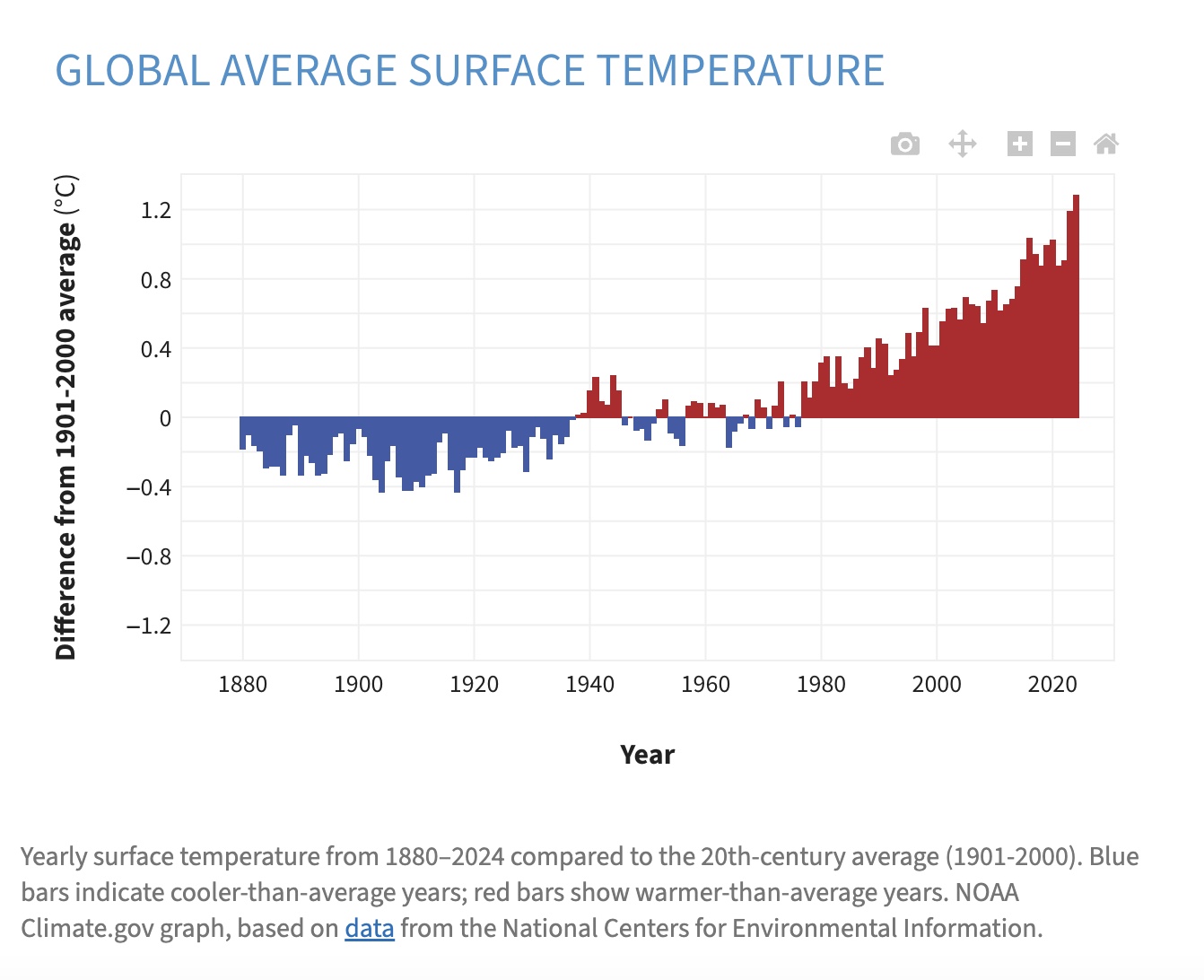
- The graph below shows the global average surface temperature from 1880-2023. Earth’s temperature has risen by an average of 0.11° Fahrenheit (0.06° Celsius) per decade since 1850, or about 2° F in total, but the rate of warming since 1982 is more than three times as fast: 0.36° F (0.20° C) per decade.
- Climate change is causing a significant loss of both Antarctic, Arctic, and Greenland ice. The shrinking sea ice extent and melting ice sheets, leads to rising sea levels and other global impacts. (reference)
- Arctic ice loss since 1900 is about 95%
- Antarctica is losing an average 150 billion tons of ice per year
- Greenland losing about 270 billion tons per year (reference)
- Impacts of global warming are numerous and impacting all 8 billion residents of planet Earth. However, the impacts are felt most severely in more impoverished cultures. (reference)
- Hotter temperatures
- More severe storms
- Increased droughts
- A warming, rising ocean (due to loss of global ice sheets)
- Loss of species diversity
- Not enough food to feed the planet
- More health risks due to diseases like Dengue fever
- Poverty and displacement from ruinous storms
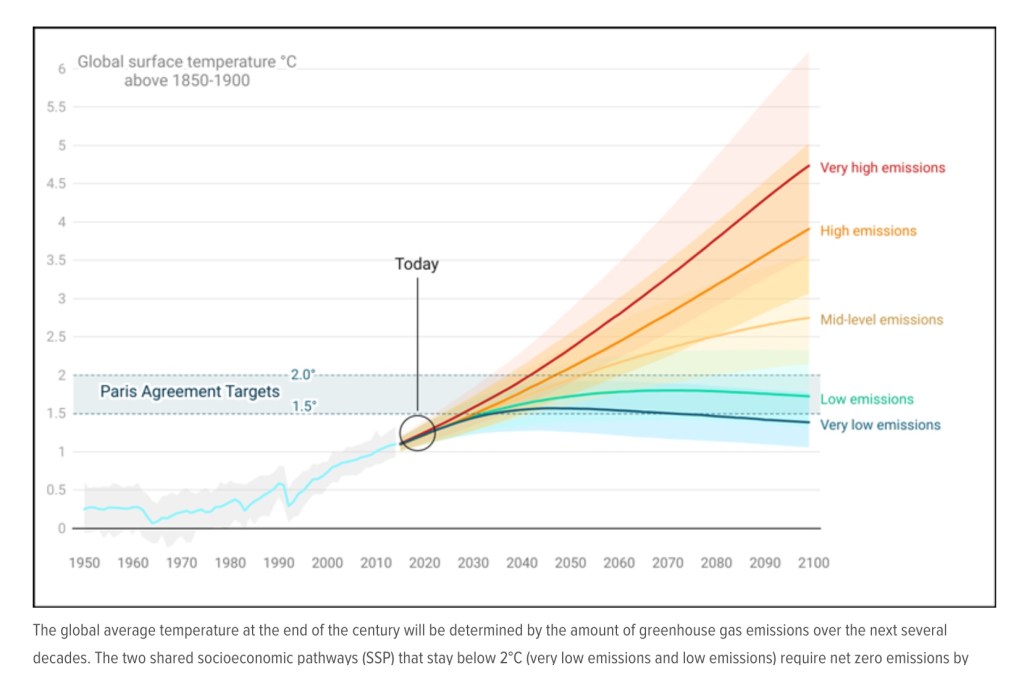
Because of human activities over the past 200 years, the average global temperature in 2024 was 1.46oC higher than in pre-industrial times. Climatologists are unanimous about the fact that we must stay below the 1.5oC threshold, which was established in the Paris Agreement. This target is crucial for us to mitigate the most severe impacts of climate change. Without a concerted effort to control our insatiable desires for fossil fuels and animal consumption, we will reach 2.0oC, the tipping point, by ~2050. At that point, it might be too late because there will be too much greenhouse gases in the atmosphere. (see graph below1)
Brian McLaren writes a sobering challenge to all humans on page 70:
If we’re going to evade the Collapse/Extinction scenario, it’s going to require a lot of people making a break with the old religious and economic stories that aid and abet ecological overshoot. We’re going to have to step away form the harmful stories that brought us here, the stories that give us a self-righteous “our livers matter and to hell with everything else” spirit. Deconstructing failing stories and reconstructing new ones, we might say is not just a matter of personal spirituality or ideology: it’s now a matter of planetary survival.”2
McLaren asks the question at the end of chapter 5: “Where might a new story arise?” I believe new stories will have to come from: (1) scientists that are calling for change; (2) informed citizens who will make individual changes in their habits; (3) communities that rise up to support collective change (green buildings or conservation efforts); and (4) countries that are resolute about shifting to renewable forms of energy. McLaren believes that unless we start creating and telling new stories, we will stay bound to the old stories. These old stories are what landed us here.
So what can we do individually or collectively to positively impact the situation in which we find ourselves. “Take the first step, the step you don’t want to take” (in the words of David Whyte3).
- When possible walk, ride a bike, or carpool
- Drive a low-carbon vehicle & move away from the SUV mindset
- Change your driving habits to conserve fuel4
- Avoid Flying, Fly Less Frequently, and Fly Shorter Distances
- Replace your appliances with Energy Star rated appliances
- Insulate your home
- Lower your thermostat and where warm clothes around the house or apartment
- Cut meat, chicken, fish and dairy out of your diet. Adopt a vegetarian or vegan diet.
- Follow the four R principle: Refuse, reuse, reduce, and recycle5
I hope this essay helps you understand the importance of adopting a new story. It is about our individual and collective responsibility to combat climate change. I would like future generations to look back on this time and say wisdom, not greed, prevailed.
References:
- Copernicus: 2024 is the first year to exceed 1.5°C above pre-industrial level, European Commission, Copernicus Eyes on the Earth. ↩︎
- Life After Doom, Brian McLaren, 2024, page 70 ↩︎
- https://davidwhyte.substack.com/p/start-close-in-ec8 ↩︎
- https://natural-resources.canada.ca/energy-efficiency/transportation-energy-efficiency/personal-vehicles/fuel-efficient-driving-techniques ↩︎
- https://youtu.be/MqAyI6caMv4?si=iY0iah0ZNyAU_Z-l ↩︎
 rryshke.org
Leave a comment