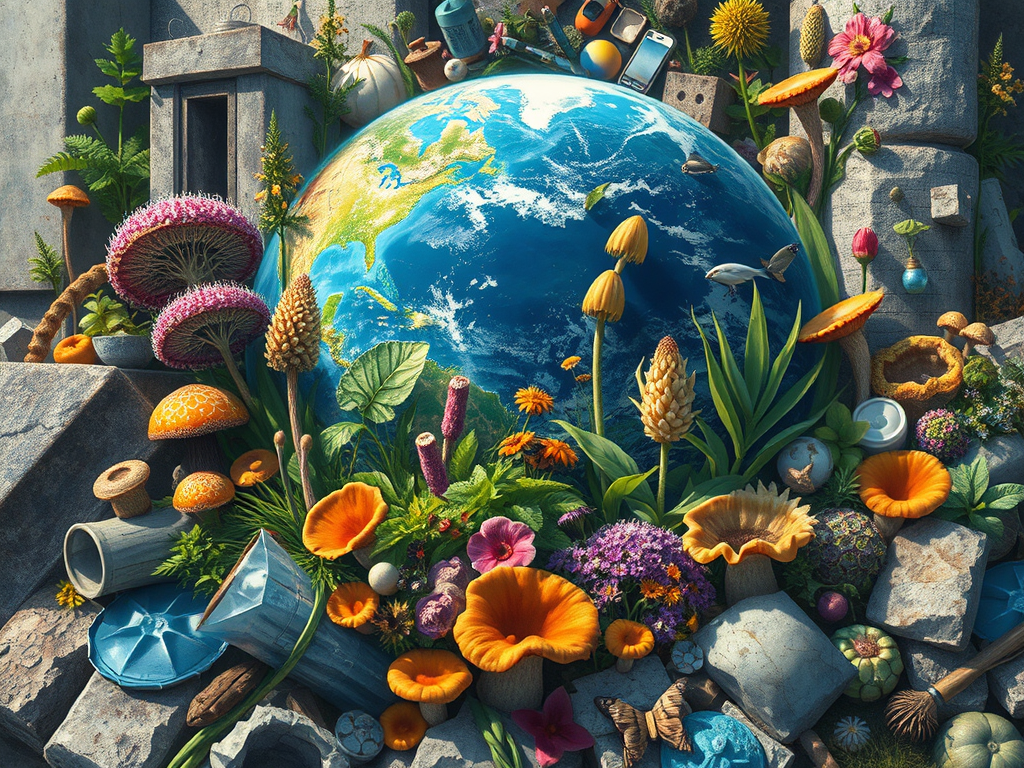
The New York Times ran an article, A Century of Human Detritus, Visualized, in the Science Times this week that drew my attention and challenged my thinking on consumption. I wonder what you think of the opening paragraph.
It took roughly four billion years for the first living bit of protoplasm , bred perhaps in an undersea volcanic vent or a warm pond, to grow and evolve into 1.1 trillion tons of biomass that inhabit the Earth today. But all of that is outweighed by the plastic, concrete, and other material that humans have produced in the last century alone in the form of everything from roads, skyscrapers to cars, cellphones, paper towels and bobblehead dolls. (reference)
The 8 billion Homo sapiens represent only 0.01% of all the biomass on Earth. In the biosphere, we are a mere drop in the bucket when it comes to numbers and biomass. For example:
- estimated number of ants on Earth: 20 quadrillion
- Ratio of ants to humans: 2.5 million ants per human
- estimated number of livestock animals on earth: 31 billion
- estimated number of humans on earth: 8 billion
- Ratio of livestock to humans is about 4:1
Another example from a biomass perspective:
- estimated biomass of fungi on Earth: 12 gigatons of carbon
- estimated biomass of humans on Earth: 0.06 gigatons of carbon
- Ration of fungi to humans biomass is 200 to 1
What’s the point? We are a tiny part of the total number of organisms on Earth, both from a numbers and biomass perspective. We need to see ourselves as just one part of a complex living ecosystem. We are not the most important part. All of the parts function interdependently. Remove one part and the ecosystem is at risk of collapse.
We are only one part of the Earth’s ecosystem. However, we have played an extraordinary role in shaping the Earth over the past 125 years. The last two graphs in the article illustrate this point in dramatic ways. In 1900, the biomass of living organisms far outweighed the mass of human-made things. By 2024, the mass of human-made things far outweighed the biomass of living organisms (reference).
According to estimates, the total biomass on Earth is about 550 billion tons of carbon (Gt C). The majority of this biomass is plant-based. In contrast, in 2024 there is an estimated 1.3 trillion tons of human-made stuff (concrete, aggregates, bricks, asphalt, metals, plastics, etc.). That means there is 2.4 tons of human-made stuff to 1 ton of biomass.
All this human-made stuff came from using Earth’s resources to satisfy our human needs and desires. We have a much greater influence on the Earth, especially over the past 125 years, than any other living organism. Dr. Menard, a physicist from Johns Hopkins, said: “Earthlings have built two billion cars. These cars require 700 billion tons of asphalt.” Our transportation system is elaborate and extensive. It has reshaped many parts of the planet, changing the way land is used. Also, this system has had an adverse impact on other living organisms. Finally, we use 100 times our own biomass in plastic. Much of this plastic ends up polluting the oceans and garbage dumps.
Of course, the rationalization behind all the human-made stuff is clear. It ignited the progress of human civilization since 1900. I am sure most of us would agree with that conclusion. However, at what cost to the planet? Has all the stuff we’ve created equitably benefited all humans on Earth. In what ways has all the human-made stuff and the toxic byproducts of its production irreversibly harmed the planet? While these questions may be debatable, we know that not all humans have access to the many things we’ve built. Some things, like clean air, water, and sufficient food, are still unavailable to vast numbers of humans.
So what’s to be done? First, we need to engage in a deeper and thoughtful conversation about conservation. Is our building of things outpacing our ability to manage the consequences of our actions? Can we come to equilibrium with respect to consumption versus conservation? Second, we need to talk about the inequities in accessing human-made things. These inequities are especially concerning for essentials like medicines, food, and shelter. Various sources indicate significant shortages. Earth has 2 billion people lacking clean water (reference). Almost 1 billion people lack sufficient food (reference). Additionally, 1.6 billion people lacked adequate shelter (reference). Third, we need to consider how our excessive building of things affects Earth’s limited resources. It also impacts other living organisms that are a vital part of the ecosystem.
This CNN article illustrates my final point and the inequities that exist midst the human-made stuff we create. The $1-billion Dubai skyscrapers will be linked by a daring rooftop pool. This building project represents an unnecessary use of Earth’s resources to meet the selfish needs of wealthy humans. We have to ask ourselves what is the cost to achieving a sustainable lifestyle for all people? The cost is too great for future generations. We need to find better ways to balance consumption with conservation.
 rryshke.org
Leave a comment