
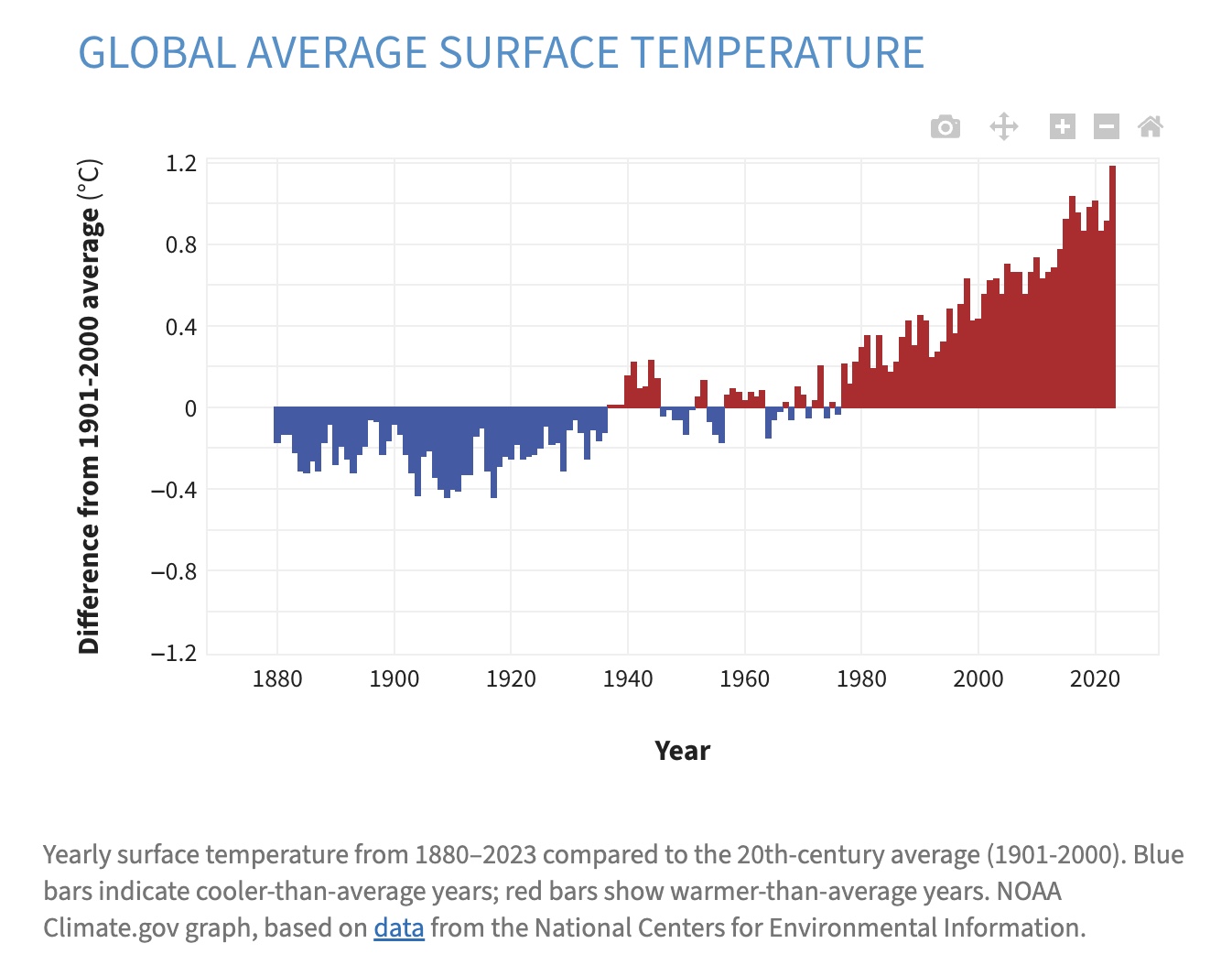
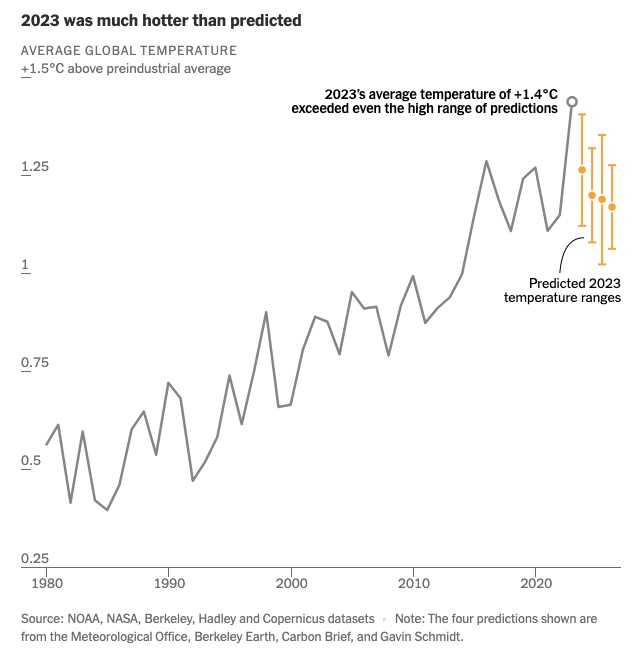
Our Planet is on the verge of significant planetary changes. These changes will lead to the collapse of ecosystems if we do not act judicially and skillfully. The two graphs below show the trends in global warming, which is a primary driver of planetary changes. This trend threatens our ocean temperature equilibrium. It also causes the melting of the world’s glaciers. The 2023 global average temperature change was the warmest on record, approaching 1.4oC. The Paris Agreement stipulates that countries “pursue efforts to limit the temperature increase to 1.5 degrees Celsius above pre-industrial levels.” We are on target to reach and exceed that value as we burn more and more fossil fuels indiscriminately.
With Donald Trump’s election on November 5, the United States will quickly face a day of reckoning. As a climate denier, our new President-elect will appoint cabinet members aligned to his philosophy. The Environmental Protection Agency (EPA), Department of Agriculture, and Department of Energy (DoE) will move the country into deregulation territory. The United States is one of the top 2 or 3 largest greenhouse gas polluters. We will continue along this path if President-elect Trump has his way and resistance is ineffective.
Here are some facts to be aware of:
- Trump’s motto is “drill-baby-drill,” which will result in more oil and gas exploration in sensitive ecosystems.
- The United States is the largest producer of oil in the world: 21.91 million barrels per day (includes crude oil and liquids) (reference)
- The U.S. is the second-largest emitter of CO2, with 5,057 million metric tons of total carbon dioxide emissions in 2022. (reference)
- As of November 1, 2024, there have been 24 confirmed weather/climate disaster events. Each event had losses exceeding $1 billion and affected the United States. These events included 17 severe storm events, 4 tropical cyclone events, 1 wildfire event, and 2 winter storm events. (reference)
- Since 2015, America’s farmland acreage has decreased by 12.39 million acres. That’s an average loss of nearly 1.8 million acres per year. There are several reasons behind this trend: climate disasters, loss of small farms, and urbanization. Cities and towns are expanding into previously rural areas. (reference)
- The loss of pollinators is a major concern. These include bees, butterflies, moths, birds, beetles, and other insects. They are directly responsible for nearly $500 billion a year to the global food production system. This is one example of loss of biodiversity which is a major engine of our biosphere. (reference)
- Coral reefs are one of the planet’s great resources. They are home to a diverse system of interdependent organisms. These reefs provide food security to a complex ecosystem.
- They face local and global threats. Ocean warming and acidification due to greenhouse gas pollution, overfishing, sediment runoff, nutrient pollution from fertilizers, and marine pollution due to garbage and plastic dumping. (reference)
- 75% of the world’s coral reefs are currently threatened, and scientists estimate that 90% could be wiped out by 2050 if action isn’t taken. (reference)
I share this short list of ecological challenges to illustrate the complexity of the problem. These challenges face the future of our Planet, the only home we have. A problem of this nature requires significant expertise, a willingness to collaborate across boundaries, a curiosity to experiment skillfully and boldly, empathy for the impact these challenges have on living and nonliving organisms, and astute leadership that brings a “beginners’ mind” to the work. A beginners’ mind does not imply a lack of knowledge or experience. It means that hard questions drive the work. Curiosity and discovery are also central to this approach.
I would argue that Donald Trump, a climate crisis denier, does not clearly understand the magnitude of the challenge. In fact, he doesn’t believe there is a problem that drilling for more oil and gas can’t solve. This attitude is dangerous to the critical work we must do in partnership with other countries around the globe.
The Paris Agreement, established in 2015 at the United Nations Climate Conference in Paris, was adopted by 196 countries across the globe. In 2019, President Donald Trump withdrew the US from the Paris Agreement because he believed it was unfair to US interests. Instead of staying involved, negotiating, and finding common ground, he removed us from the global conversation.
On his first day in office, President Biden rejoined the Paris Agreement. He knew it was our responsibility as a major greenhouse gas emitter to reinvest in the partnership. He believed we had to lead the way. The Bipartisan Infrastructure Law (Inflation Reduction Act-IRA) was enacted in 2021. Its purpose is to renovate our infrastructure and focus on lowering greenhouse gas emissions. However, the overall impact on global warming is not thought to be overly significant.
Today, the world is fearful as Donald Trump becomes the 47th President of the United States on January 20, 2025. Countries worry that he will remove the US from its responsibility to address the global climate crisis. Furthermore, reporting suggests one of Trump’s first executive orders will be to scale back commitments made in the IRA (reference).
What will be the path of the United States with respect to the Earth’s climate crisis? It’s anyone’s guess. However, the writing on the wall suggests that under a Trump administration, our environmental progress will be in jeopardy. This will endanger the goal to meaningfully cut greenhouse gases by 2050. So our call to action includes:
- a strong resistance to oil and gas drilling in sensitive ecosystems in Alaska and elsewhere;
- a continued investment in renewable energy sources to challenge our reliance on fossil fuels;
- the protection of the Planet’s biodiversity;
- the protection and restoration of vital ecosystems like coral reefs, rainforests, and other critical habitats.
Our judicial system needs to be prepared to interpret laws and adjudicate disputes in environmental cases to protect our Planet. We have to recognize that these resources are shared by all living organisms that inhabit the biosphere. This will be accomplished if we work collaboratively and share equitably. If President-elect Donald Trump’s administration fails to lead, then US citizens will have to let their voices be heard. Our future depends on it.

 rryshke.org
Leave a comment