
Writers share their wisdom and ideas for how to lead the “good life.” So much of my learning comes from them. I think of the “good life” as discovering a path that leads to my truer self. The path has no beginning or end. My daily work is to increase awareness of my responsibilities to live a “good life.” The path is filled with successes and failures. It encourages me to better integrate the wisdom traditions of those who act as guides on the side. I acknowledge the impact they have on me and others. Here are some words of wisdom from people I admire.
PEMA CHÖDRÖN
We can’t have an enlightened society or a sane and peaceful world if individuals within it are stuck in small, fixed minds. Out of our individual ability to connect with big mind and big heart-in other words, with our basic goodness-we can manifest a culture where people care for themselves and care for each other. We can have societies where we see each other’s potential, rather than seeing each other as broken or messed up. (Welcoming the Unwelcome, Pema Chödrön, page 118)
Pema Chödrön, a Buddhist teacher, asks us to stay curious and open-minded about the world we inhabit. If we connect to our heart as a source of empathy and love, we gain strength. This strength allows us to care for ourselves and others.
DAVID WHYTE
In addition to being open-minded and curious, we need to uncover meaningful ways to act that align with our values. For example, some people feel confusion, uncertainty, numbness, or anger over Kamala Harris’ loss in the 2024 Presidential Election. Midst these feelings, they wonder what to do next. For me, that answer comes from a poem by David Whyte, Start Close In. Here is David Whyte reading his poignant and lucid poem.
In Start Close In, Whyte writes: “Start with the first thing close in, the step you don’t want to take.” Whyte suggests we find the courage to do the thing that demands a little more of us. The thing that is hard to do but is right in front of our eyes. In Harris’ election loss, we can stay present to our feelings of grief or loss. Try not to push them away or expect our “normal life” to return soon. Take the first step, not the second or third!
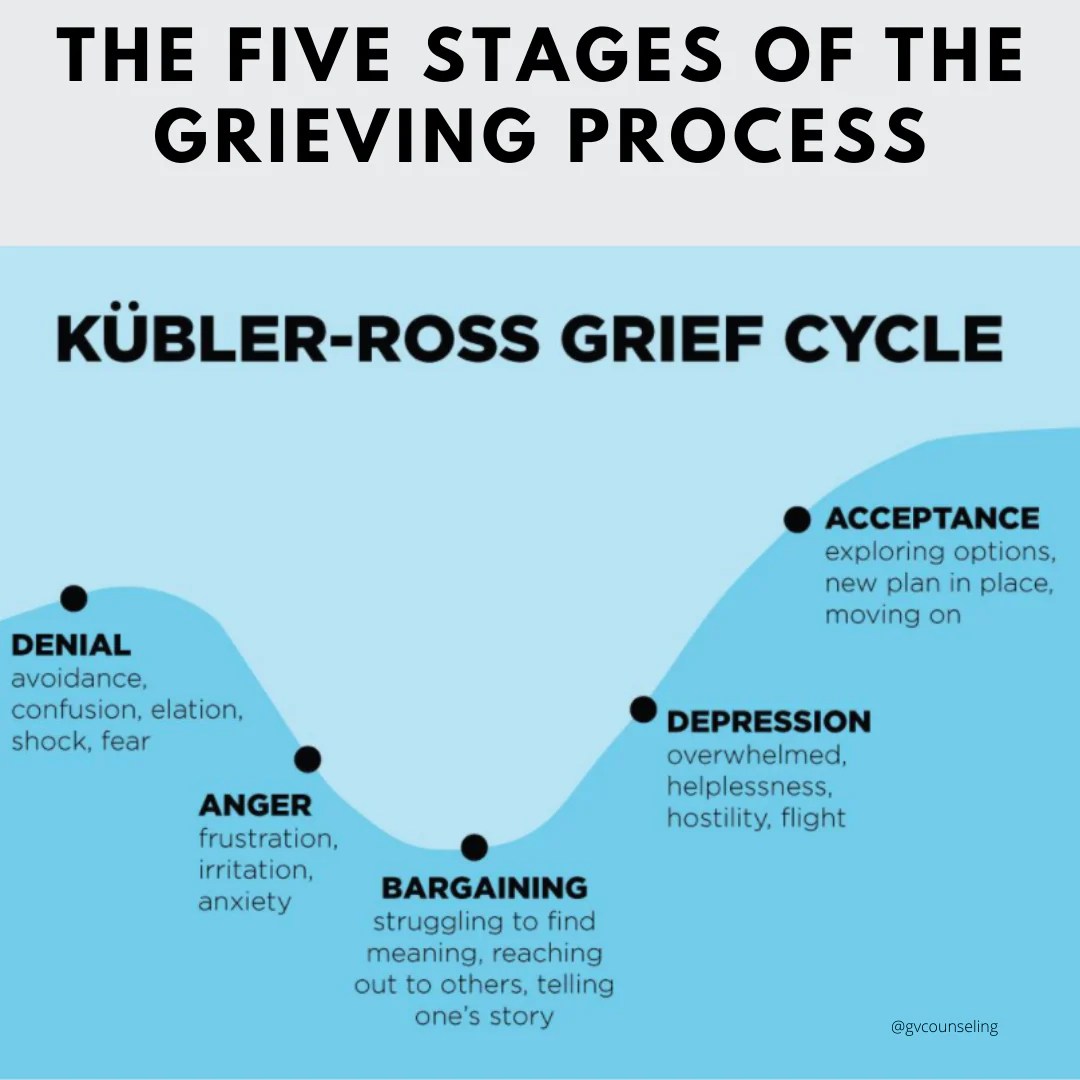
I am taking some lessons from the five stages of grief model developed by Elisabeth Kübler-Ross. The stages are shown in the figure. As someone who supported Kamala Harris, I am definitely in the denial and anger stage. It is going to take time to reconcile these feelings. Emerging into the acceptance phase will require making some changes in how I think about what’s happened. Then I can take the second, third, or fourth step as Whyte suggests in his poem.
MEG WHEATLEY
In her book, Finding Our Way: Leadership for Uncertain Times, Meg Wheatley writes:
If other don’t feel safe, we aren’t safe. If others are struggling, we experience the consequence of their struggle. If others are poor. no matter how wealthy we are, we experience the consequences of their impoverishment.
Many great teachers have been trying to teach us this for thousand of years. Buddhism teaches that any one thing is here because of everything else. Jesus said that if “ye are not one, ye are not mine.” Chief Seattle reminded us that “the earth does not belong to us; we belong to the earth.” And the American naturalist, John Muir, commented that when we tug on any one part of the web of life, we get the whole web. But in spite of such timeless and ancient wisdom, we’ve turned a deaf ear on all these wise ones. (page 204)
These are important words to reflect on and integrate into our way of being in these uncertain times. Through this challenging election season, many people don’t feel safe. So none of us are safe. Some people support a woman’s right to choose and yet voted for Donald Trump. They do not feel safe sharing their reasons for fear of being criticized for seemingly inconsistent behavior. Other people do not support transgender rights and yet voted for Kamala Harris. They too do not feel safe to share their feelings or reasons. In the end, if we cannot honestly share without fearing retribution, then society is unsafe.
Wheatley’s quote also highlights another aspect. It pertains to our enormous wealth gap in the face of many citizens struggling to meet their basic needs. We all struggle with the consequences of impoverishment amongst our brethren. There is no escape other than disconnection.
Through the words of these three wisdom thinkers, we can work to build societies where we see each others’ potential, allowing our true selves to emerge. Our challenge is to take steps we typically don’t want to take. For example, to create real systems of equality we must do at least three things. First, we need to tackle the climate crisis that chokes off peoples’ promises. Second, we must halt the rapid loss of biodiversity. This loss threatens our Planet’s health. Diversity is one of its engines for change. Third, we must learn to share resources so that all human and nonhuman organisms on our Planet can thrive. Creating real systems of equality is a complex challenge. These changes can happen; however, we must act responsibly and listen to spiritual or wise thinkers who can guide us.
CONCLUSION
The truth is that we can’t do this work alone. It is only through community that our efforts for a just society are possible. There is the famous Helen Keller quote: “Alone, we can do so little; together, we can do so much.” But the journey has to start with each of us growing our self-awareness.
References:
Welcoming the Unwelcome: Wholehearted living in a brokenhearted world, Pema Chödrön, 2019
Start Close In, a poem by David Whyte,
Finding Our Way: Leadership for Uncertain Times, Meg Wheatley, 2005
 rryshke.org
Leave a comment