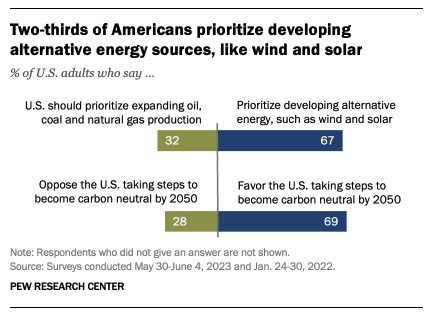
In the United States political arena, we are still squabbling about whether global warming is influenced by human activity. While 97% of climate scientists unanimously agree that human activity is the single most important factor causing our planet to warm, which is adversely changing in our climate, 32% of Americans are in favor of continued expansion of the fossil fuel industry. They don’t see a direct correlation. See Graph 1 below from a study completed by the Pew Research Center. If Americans are going to make significant gains, they must unanimously adopt the views of 97% of climate scientists. This will help avoid climate catastrophe. We have work to do on the local and national level to change the trajectory. In addition, our role as a global leader in climate action demands alignment across our political perspectives.
NOAA, in its June 2024 report, concluded the following:
- Temperatures were above average over much of the globe with Africa, Asia and South America having their warmest June on record.
- Sea surface temperatures were record warm for the 15th consecutive month.
- Northern Hemisphere snow cover extent and global sea ice extent were both below average.
- Global tropical cyclone activity was below average, with only two named storms.
- June 2024 was the warmest June on record for the globe in NOAA’s 175-year record. June 2024 marked the 48th consecutive June with global temperatures, at least nominally, above the 20th-century average.
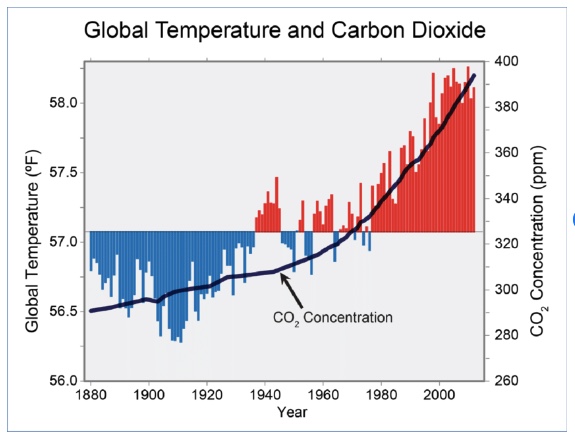
In reading these five conclusions, NOAA is suggesting that the planet, both surface and ocean temperatures, is the warmest it has ever been. I would suggest there should be no argument about the pattern we see. In addition, Global annual temperatures have been steadily increasing. Carbon dioxide (CO2) levels have also been steadily increasing, with some fluctuations occurring over time (see the Graph 2 below). Here is where the connection between a warming Earth and human activity is observed. Human industrial activity is the driver that puts increasing levels of CO2 into the atmosphere. In 2023, global carbon dioxide emissions from energy sources increased by 1.1% to reach a record high of 37.4 billion tons up 410 million tonnes from 2022 or 1.5% (reference).
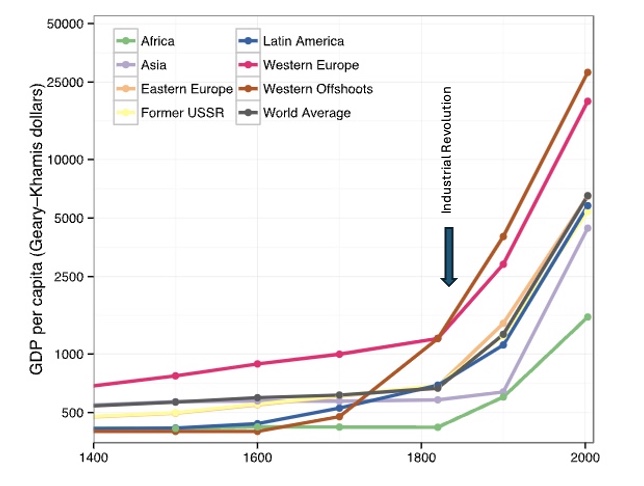
Graph 3 shows the relative increase in GDP per capita over time. The rapid increase after 1800 coincides with the beginning of the Industrial Revolution, which begins in Europe around 1820-1840. It was at this point in human history where we began using fossil fuels like coal, oil, and gas to fuel innovation. While this innovation was essential for our society to evolve, there has been a great cost to the health of our planet.
So a snapshot of some data, as seen in Graphs 1-3, would indicate that a significant minority of people are unaware of the relationship between warming temperatures, increasing CO2 levels, and exponential growth of human activity starting with the Industrial revolution. The increasing levels of CO2, a greenhouse gas, act as a heat blanket over Earth, blocking infrared radiation (heat) from escaping the atmosphere causing temperatures on the surface to increase. Water has a very high capacity, so it can absorb large amounts of heat energy without drastically changing temperature. The ocean absorb a large amount of heat, storing an estimated 90% of the excess heat energy trapped in the Earth’s climate by greenhouse gases like CO2.
Climate change is worsening hurricane impacts in the United States by increasing the intensity and decreasing the speed at which they travel. For example, Hurricane Debby, a category 1 storm, had a forward speed of 3 miles per hour, which meant that most of its destruction was from torrential rains and flooding across the southeastern parts of the United States. Debby caused 78 deaths, billions of dollars in damage, and impacted millions of people.
Scientists are now uncertain whether there will be a change in the number of hurricanes, but they are certain that the intensity and severity of hurricanes will continue to increase. These trends are resulting in hurricanes being far more costly in terms of both physical damages and deaths. To avoid the worst impacts moving forward, communities in both coastal and inland areas need to become more resilient.
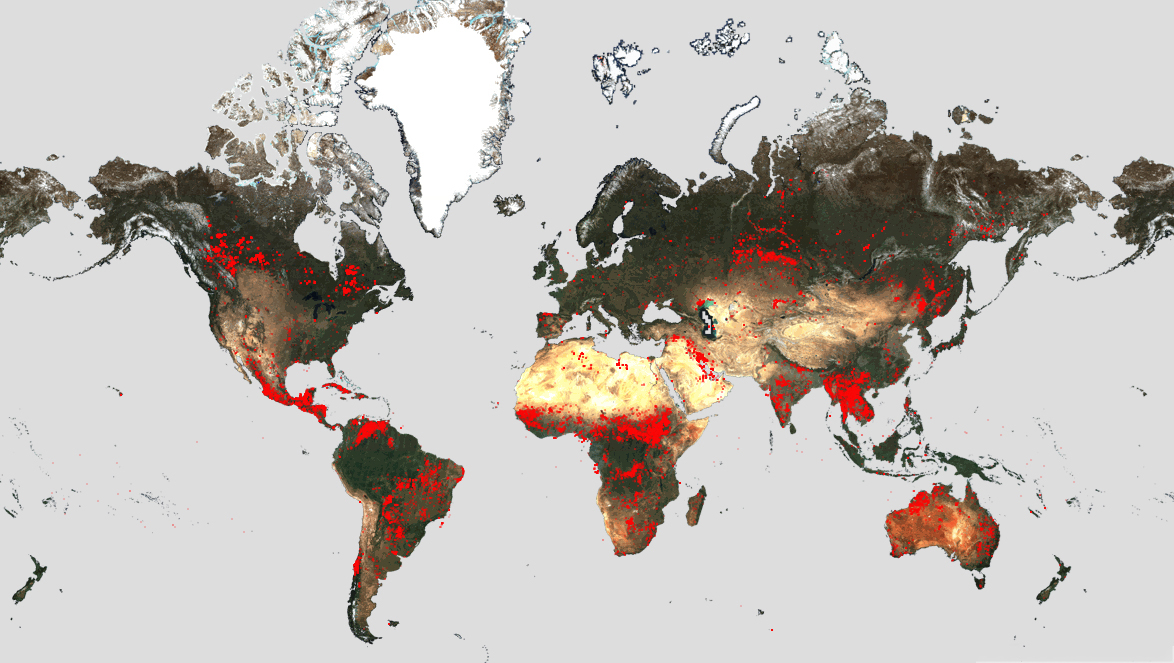
2023 was a year of intense wildfire activity in many regions, including the United States, Canada, Africa, and Greece. Canada’s wildfires produced the highest carbon emissions in the CAMS record since 2003, accounting for 22% of the estimated 2,170 mega tons of carbon emissions produced by wildfires globally in 2023. Greece also experienced its largest wildfire to date, which was the largest in the European Union. Graph 4 shows the “hotspots” around the globe for 2023 wildfires. While wildfire damage to forested land and. human structures is readily apparent, non-human animals are also negatively impacted. For example, “Australia’s wildfire crisis in 2021 was one of the worst disasters in modern history. The fires killed or displaced nearly 3 billion animals.”
In the United States, the squabbling about whether global warming is real and driven by human activity has to resolve itself so that we can assume a leadership role in addressing this global crisis. Our credibility to lead in this space is diminished because our leaders can’t unite, acting locally and nationally with one voice. The top three greenhouse gas emitters — China, the United States and India — contribute 42.6% total emissions, while the bottom 100 countries only account for only 2.9% (reference). These three countries have to be role models for drastically reducing their greenhouse gas emissions before it is too late.
Everyone can play a part by taking simple steps.
- Vote for politicians who are committed to addressing climate change.
- Invest in conservation strategies for your home and community.
- Invest in fossil fuel saving strategies: use alternate modes of transportation when possible, making energy saving purchases, and use reusable water bottles.
Feel free to share other examples of how to be stewards of a healthy planet in the comment box or ways in which climate change has impacted your lfe.
 rryshke.org
Leave a comment